You Say T’mater, I Say Don’t Wait ’til Later

“Strike,” they say, “whilst the iron is hot.” Or, in this case, pick when the fruit is ripe.

All over this fair country, not to mention most of the Northern Hemisphere, those all-too-few brief weeks we all wait for have arrived. Yes, it’s Tomato Time.

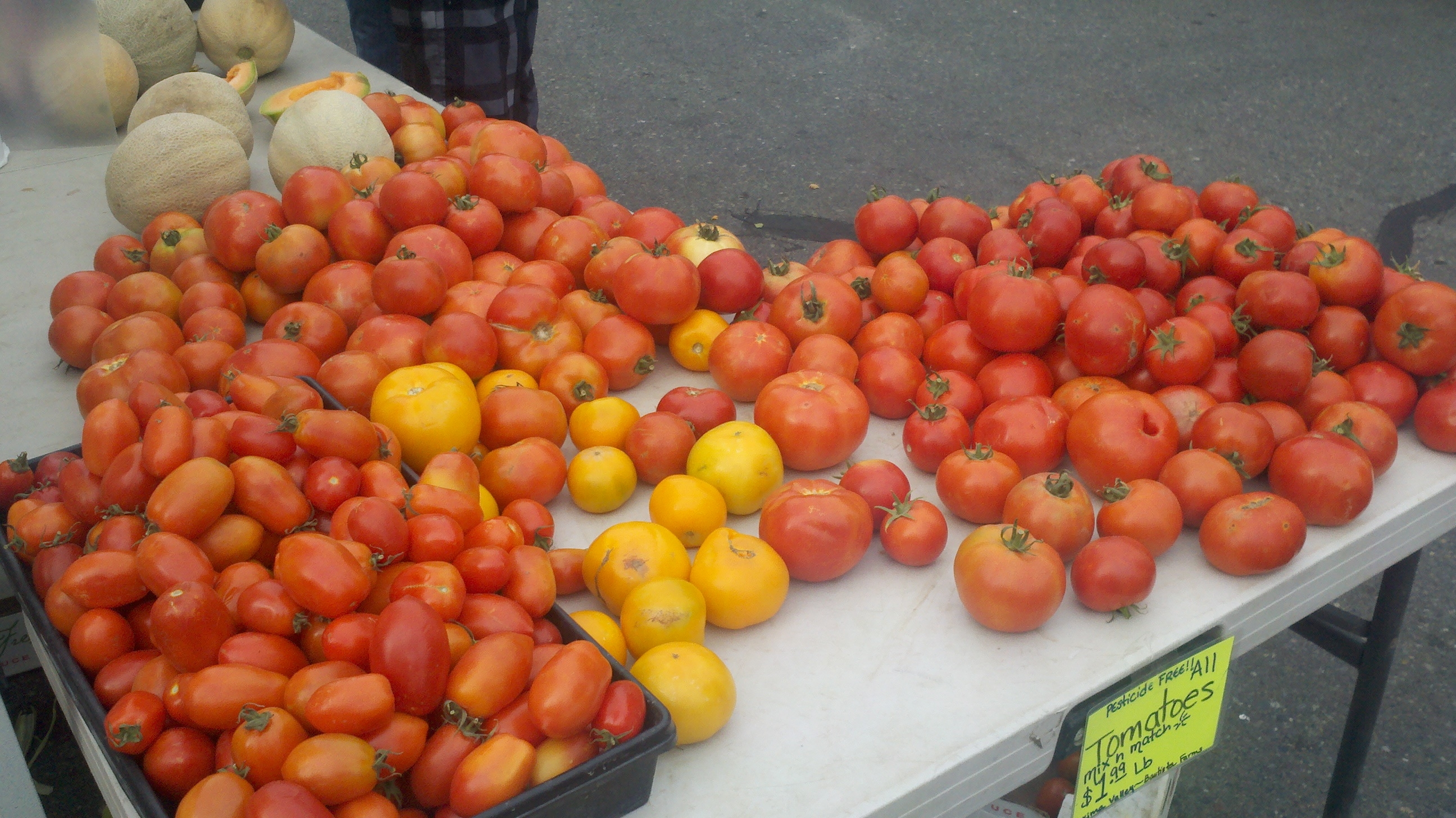
Farmers Market Toms

Of course, you can purchase tomatoes at your local mega-grocery-warehouse store 12 months of the year. That is not to say that those purchased anytime after September 30 or so will bear any resemblance to the real thing. To get a real tomato — one as red inside as it is out, a perfect balance of sweet and acid, juicy and heavy in your hand — this is your window. As in now.

Interestingly, the tomato — like many items in your typical produce section — has been severely compromised in quality over the years. Compromised to the point that it is difficult to get a great-tasting tomato unless you careen off-grid.

Of course, this has resulted from your garden-variety, agri-industrial culinary conspiracy.  For several years now, the only tomato available from most corporate-super-giant-mega-valu grocers (not to mention Walmart) is a gassed-up fruit. That’s right: gassed. These days, with the near-total demise of the independent corner grocer, almost all tomatoes (not to mention most everything else you eat) are procured from exotic far-off lands like Florida and California, where the growing is less farming and more industrial in nature. Tomatoes are picked hard and green so that they can be shipped without damage. Realizing that few among us will actually eat green tomatoes unless they are battered and fried, something has to give. To turn them a palatable red color, the fruits are subjected to ethylene gas, long known and oft used to quicken the ripening process.

For the moment, let’s assume that ethylene gas is totally benign, with zero harmful effects to humans. For the moment.

The only thing that ethylene does for a tomato is to turn it red. A gassed tomato, while appealing to the eye, yields no flavor and a gross, mealy texture. You may wish to spend some three dollars and fifty cents a pound for an inedible mess, but count me out.

Out of season, I satisfy my tomato cravings with something out of a can. For example, Italian canned tomatoes (sold under the San Marzano brand) are delicious and easily a cut above such well-known American brands as Hunt’s. A recent taste test in Cook’s Illustrated gave the gold medal to Muir Glen, which cans an organic tomato.

It figures, though, that canned tomatoes — while a viable and preferred option from a taste standpoint — are not without issue. Tomatoes, being highly acidic, leach bisphenol A (BPA) from the lining of cans at a rate that is significantly higher than other canned products. The toxicity of BPA is still being debated, so if you are one who is uber-careful about chemicals in your system, consider yourself warned. As for me, I eat few commercially canned products anyway, so a little BPA seasoning isn’t a significant worry. I am more concerned about the spare tire forming around my middle, not to mention the growing amount of junk in my trunk.

But back to tomatoes — fresh, ripe, juicy tomatoes. Where I live, this is the time to get them, and the best place is at a farmer’s market or a roadside stand. That is, if you don’t have a garden patch of your own where you can DIY your own produce. Tomatoes would be my number-one crop if I could get them to grow in this cool, damp, maritime climate that I prefer. When I lived on Vashon Island and had a largish patch of productive soil, I devoted half of it to tomatoes. Just before harvesting my first batch for canning purposes (probably 25 pounds of splendid Roma “paste” tomatoes), I noticed some little soft spots on the ends of the fruit. A day later, the vines looked peaked, and three days after that, the entire crop was wiped out.

What the heck? I had never seen anything like it in my life. Turns out tomato blight is a big problem here. You need abundant sunlight and searing heat to effectively grow tomatoes, both of which are in short supply in what passes for summer here.

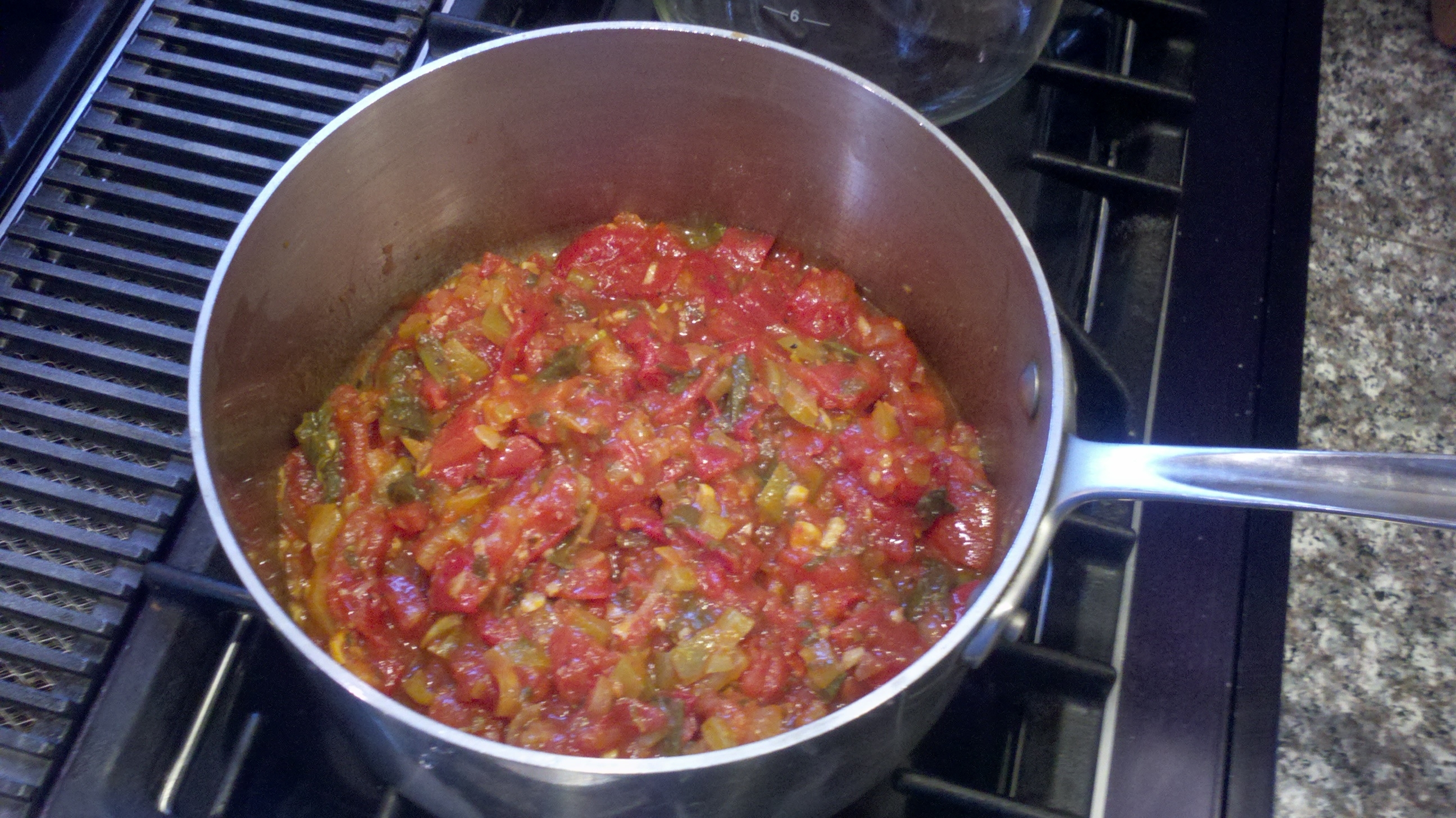
So instead of growing my own, I lurk at the local farmer’s markets and procure my fix from growers in Yakima. Last week, I got the most splendid juicy beefsteak tomatoes for just $1.49 per pound, and in a couple of weeks, I will buy a batch of Romas for even less. These I will turn into a lightly cooked tomato sauce, with fistfuls of garlic, some sweet onion, and perhaps some mild Anaheim peppers. This mixture will be frozen in plastic bags, because I am too much of a ninny to actually try hot canning. When thawed, some months into the future, it will be a little taste of summer.

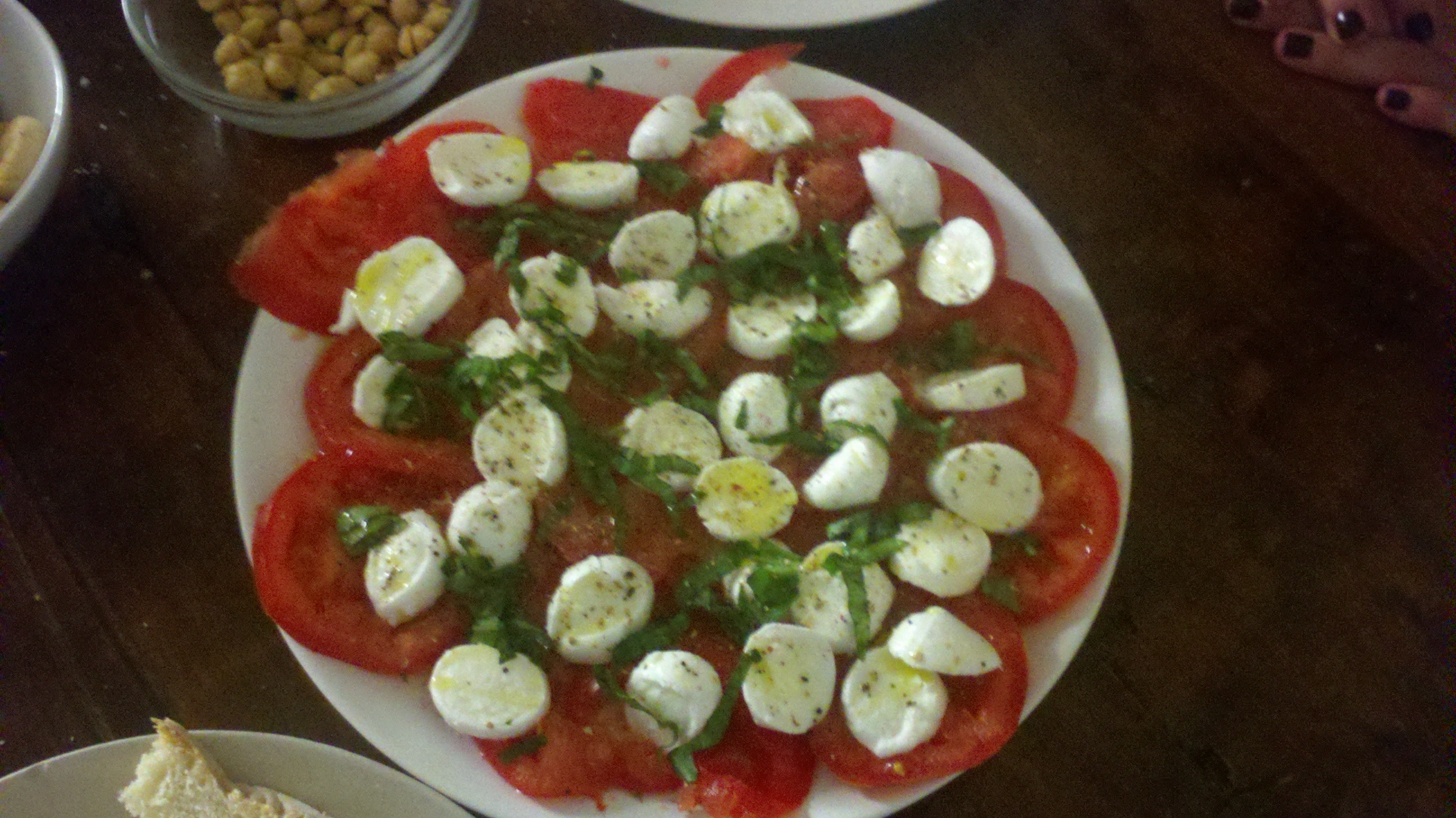
There are about a million things you can do with lovely tomatoes (give or take). For example, on a family trip to Cinque Terre and Tuscany last summer, I became obsessed with a salad called Caprese. In classic Italian tradition, this salad is an exercise in perfect simplicity: succulent, sun-ripened tomatoes; torn fresh basil leaves; excellent (not to mention expensive) extra virgin olive oil; miniature spheres of buffalo mozzarella; sea salt and cracked pepper. So simple you can’t even call it cooking — it’s more accurately described as assembly — but it is refreshing and insanely delicious.

Cross over a range of mountains or two from where we were and you will find tomatoes Provençal, another splendid dish that recognizes the star of the show and never steals the scene with a supporting player. This is simply a mixture of breadcrumbs and whatever combination of fresh herbs you have on hand, which is packed into a large halved tomato with the seeds removed, then slow-roasted until soft. Veganism at its best — that is, sans political overtones.

While Italy and France are famous for their tomato preparations, a country that is less recognized for its efforts is Spain. Here in the land of pan con tomate (toasted bread rubbed with ripe tomato), inspired chefs are reenvisioning such dishes as tomato tartare and confit of tomato . . . you know, those old things. You would be surprised how easy some of these dishes are, not to mention how delicious.

This is the time, gentle readers, as summer slips slowly into fall. Before long it will be apples and chanterelles, but for now, it’s ‘mater time. Get thee to the local roadside stand and load up — don’t be shy. I’ll see you there.

Linguine with Fresh Tomato Sauce and Squid

Romas are good for this dish, but virtually any type or color will do. A mixture of red and yellow fruit yields a dish pleasing to both eye and palate. If you aren’t fond of or can’t find squid, shrimp would be an acceptable substitute.

Two lbs. sun-ripened tomatoes, peeled, seeded, and roughly chopped

4 cloves of garlic, chopped

Half a small onion (Walla Walla or Vidalia sweets are best), chopped

One Anaheim pepper, chopped

2/3 cup chopped fennel bulb (optional)

Fresh herbs, such as basil (necessary), oregano, thyme, marjoram (optional)

White wine

1 lb. cleaned squid, body cut into rings, tentacles included whole

To peel and seed the tomatoes, cut a small X into the end of the fruit opposite the stem. Plunge them into boiling water for a couple of minutes, until the skin is splitting and beginning to peel back. Remove and place into a cold water bath. When cool enough to handle, remove the skin, which should now peel off easily. Cut the tomatoes at the equator and carefully scoop out the seeds with a finger. Discard seeds and skins.

Sauté onion, garlic, fennel, and peppers with olive oil in a large sauté pan until softened but not brown, about four to five minutes on medium heat.

Deglaze pan with a shy cup of white wine. Reduce by half.

Add peeled, seeded, chopped tomatoes to the onion and wine mixture and bring to a simmer. Simmer on low until the tomatoes begin to soften. Tear basil leaves (or leave small ones whole) and add to the hot mixture along with chopped herbs. Salt and pepper to taste. If the tomatoes are very sweet, you might be surprised by how much salt is necessary. Add it gradually, so as not to overseason.

Before the tomatoes are completely falling apart, add the squid and cook until it’s just turning white — just a few minutes. Be sure to have the linguine ready before adding the squid to the tomatoes. Do NOT overcook the squid; it will turn rubbery.

Toss tomato/squid sauce with linguine and serve immediately with crusty bread and perhaps some grilled vegetables or a tossed salad.

I would drink any number of wines with this dish: crisp and clean Pinot Grigio, a chilled rosé, or even a lighter red like a Pinot Noir or Beaujolais would work fine.

Now, do me a solid and tell me your best recipe for ripe, in-season tomatoes. Or dish on your favorite farmer’s market or roadside stand. Don’t be shy. Dish!

And eat well.

Posted in Uncategorized | 2 Comments

Nobody Expects…Little Fishies

Expect the unexpected, that’s what I say. “No one expects the Spanish Inquisition” — not even the Pythons.

Don’t you just love it when some perfect treasure turns up right where you were least expecting it? For example, I was in New York recently on a family spring break to visit absurdly expensive colleges. Unable to sleep, I rose early and went for a walk around our deserted neighborhood on a chilly Chelsea morning.  Chelsea verily throbs with human energy during the day, but early on, like much of the city, it’s as quiet as a bar mouse. I got a hot black coffee at the Chelsea Market and set out on foot.

Just around the corner I discovered the High Line, an elevated, abandoned railroad line now transformed into a suspended park. Pure genius! Equal parts hanging garden and hoisted hiking trail, the High Line is one and a half miles of wildflowers, thickets, grasslands, sunbathing lawns, resting benches, cunning birdhouses, and public art. All this, emerging from a rail line whose original purpose was to ferry animal carcasses and produce to and from the adjacent Meatpacking District. What a delight.

But only in the morning. On a sunny Saturday afternoon, the High Line is packed shoulder-to-shoulder and provides a distinctly different experience. Oh well, timing is everything. The timing you want for the High Line is early on a workday, when you have it to yourself and the temperature is cold enough to see your breath. That will do.

One of my favorite surprise treasures is the urban fishing hole.  Perhaps the best I know of is on the upper Mississippi River in downtown Minneapolis. Between the two downtown dams and right across from the ship locks is an island, upon which sits a small power plant whose outflow creates a haven for competitive white-water kayakers. The soft water right next to the power plant outflow supports tremendous numbers of smallmouth bass, who no doubt rest in the calm seam, feasting eagerly on all manner of minnow, leech, and aquatic bug. What the  hey, right downtown. You can angle all day and then stop in for a cocktail at St. Anthony Main, if you don’t smell too fishy. Leave your stringer of smallmouth in the cooler and enjoy a Summit Pale Ale at Pracna.

Discovery works the other way as well. One of my favorite upscale restaurants I found in the most unlikely of places, the former cow town of Livingston, Montana. Chatham’s Livingston Bar and Grille is no longer in business, but I was treated to several meals there, meals of uncompromising quality. Only a true food-geek will admit to this, but yes, I have indeed adjusted (to contortionist levels) my travel itinerary to accommodate an overnight at the Murray Hotel and a lengthy meal at the LBG. Although Chatham’s culinary palace is now kaput, there are other worthwhile emporia (2nd Street Bistro, Adagio) in Livingston, and the Murray Hotel is practically worth the stop in and of itself. And then there is the fly-fishing . . . Fine dining inMontana — who’da thunk?

This would not be Meezenplace if I didn’t eventually come around to cooking. Lately I’ve been indulging, when I can, in a new edible epiphany — at least, new to me. This comestible, while exotic (or at least underappreciated) on these shores, is a common treat in the Mediterranean– celebrated there, even. However, when I mention it around here, the reply I get is pretty much, “Meh,” or even more often, “Eww.”

That food? Sardines.

See? I told you. I can see your nose wrinkling up from here. But to paraphrase Franz and Hans, eat them now and believe me later. Sardines are drop-dead delicious.

Of course, I’m not talking about the King Oscar variety, tinned in oil, tomato sauce, or spring water, although in the right hands (usually those attached to Spaniards or Italians), the little canned fishies are tremendous. No, I am talking about silver-bright, sea-fresh mini-torpedoes. Clocking in at 10–12 inches in length, fresh sardines have a lot going for them. For one, they are a sustainable fish, environmentally friendly to the max. The Monterey Bay Aquarium Seafood Watch (www.montereybayaquarium.org) lists Pacific sardines as a “Best Choice,” the highest consumption ranking available (the MBA Seafood Watch is a great science-based source for making eating decisions that don’t ruin the environment).

Second, sardines are healthy. Chock-full of antioxidant omega-3 fat (even more than salmon), sardines are a less invasive alternative to angioplasty. They accomplish this by eating plankton at the top of the food chain, so they absorb little in the way of mercury, PCBs, and other nasties floating in our ocean currents.

Of course, if sardines tasted like mud-hole carp, I wouldn’t care a whit about their sustainability status or their Fountain-of-Youth qualities. But dang, they are delicious. I recently had one of these lovelies as an appetizer at the Tilikum Place Café inSeattle’s Denny Regrade neighborhood. Tilikum’s version was stuffed with a pureed mirepoix of sautéed onion, carrot, and celery, wrapped in prosciutto, and then grilled until crispy. Wow. I have cooked mine at home a couple of different ways: grilled on the Char-Broil after a short marinade in olive oil, lemon, and garlic, or butterflied, then dredged in panko and sautéed. Yum!

Vapor lock of the brain can be the only explanation for not mentioning previously that sardines — in addition to being sustainable, healthy, and tasty — are dirt CHEAP. The other day I procured several nice ones for a dollar per pound. One dollar. Ten dimes. That is about a buck per fish, with two of those being more than I can eat. I can’t think of anything else I buy that’s decent to eat (much less delicious) that is also this cheap — and when you are the kind of penny- pincher I am, that is saying something.

So the question is: Why do you have to hunt high and low to find fresh sardines in this country, even in a place likePuget Sound? The answer shows just how insane we have become when it comes to food. Most of the sardines caught in this country are fed not to humans but to farmed salmon, in the form of processed fish pellets. This is the kind of thing that makes me go all Lewis Black, f-bomb-dropping crazy. You are kidding me, right? Fish pellets? For farmed salmon? This is the fish that has to be injected with orange dye before sale, because in its natural state it is GRAY and people won’t buy it. And we feed those miserable penned “salmon” a food that we should be eating ourselves, fish that are environmentally friendly, healthy, tasty, and DIRT CHEAP. &^^%^&@$&^$@!

How crazy are we? Don’t answer that. We are, after all, the same people that plow up millions upon millions of acres of bountiful prairie to grow corn to feed to beef that can’t actually digest it so they can get fat and . . . aw, don’t get me started.

I wish I had an idea of how to get us to eat like Mediterraneans, with their sardines, anchovies, hake, eels, squid, branzino, and barnacles that you find at every Podunk fish market there. We have, if not the exact stuff, the equivalent of this cheap, splendid survival cuisine. Instead, we sell ourselves designer fish at thirty dollars per pound. I’m not sure who eats half the stuff I see at my fish market, but I doubt I know them.

So, expect the unexpected, right? When going through this life, it is important to keep things open — like your eyes and ears, not to mention your mind. As for me, I like to keep my mouth open as well.

Fried Sardines

This dish is so easy it barely merits a full recipe.  However, it is so tasty, I include it here.

Panko

Salt

Pepper

Milk

Sardines (butterflied)

Lemon

The main challenge here is butterflying the fish.  Sardine bones are soft, so removing the backbone is usually optional, but if you can master this technique, it just proves your knife technique and makes for a more pleasant (e.g. boneless) eating experience.  Sardines typically come whole and not gutted.  To eviscerate, split them from the vent to the head and remove all the guts and gills, which need then to go right outside because they will seriously stink in a couple hours.  Next, carefully work a small, sharp knife from the vent to the tail, along the backbone.  Once you open up the fish, you can lift out the backbone with your fingers fairly easily. Leave the head on or off, whatever.

Season the panko crumbs with salt and pepper.  Dip each butterflied sardine in milk and then coat with the seasoned crumbs.  Fry in hot oil in a non-stick skillet until golden brown, about 2-3 minutes per side.

Squeeze with lemon and serve with a tossed mixed green salad and cold rose wine.

Eat Well.

Posted in Uncategorized | Tagged , | 3 Comments

Rainbows, Browns and Barbeque

When it comes to keeping their lips sealed and general obfuscation, barbeque pit masters and anglers leap to the front of the line. Prying pertinent information from expert practitioners in these fields is an exercise in futility. I recently encountered this phenomenon while fishing with expert Missouri River guide Dan Kelly. When a fellow guide inquired as to what Kelly had used to help my fishing partner Don Hurley and me put an unconscionable number of fish into the boat in just two days of fishing, he cryptically replied, “A drag-free drift.”

Sad to say, but with these two endeavors in particular (cooking and fishing), my ability to keep a secret is pathetic.  Hey, I’m a storyteller, not a storykeeper. Dan will be disappointed in me, but I am about to spill two secrets in one blog, which is not exactly like killing two birds with one stone, but close. You get the idea.

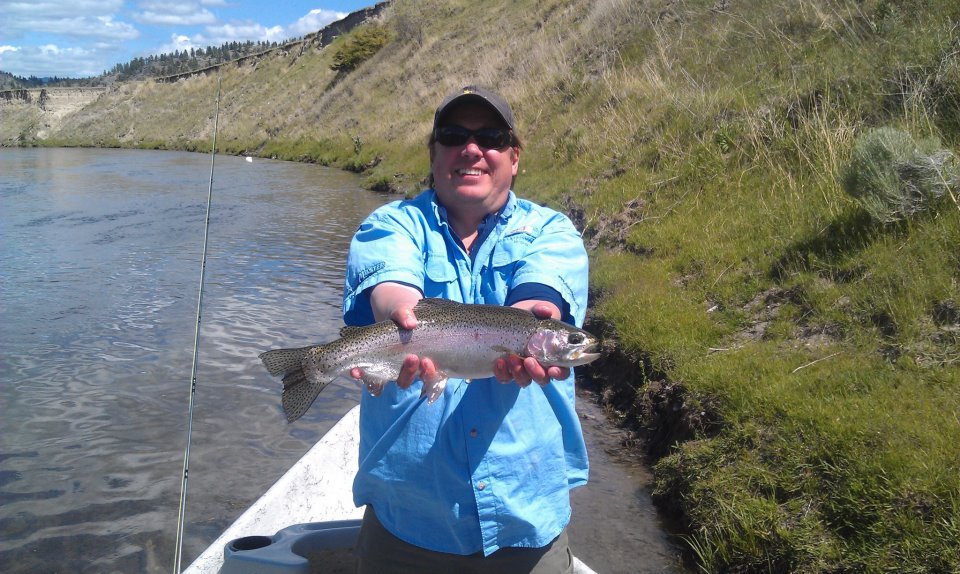
Did we catch a few fish the other day? Why, yes we did. With Kelly at the oars, Hurley (www.donhurleyoutdoors.com) and I floated an eight-mile section of the upperMissouri between the base of Holter Dam and the dirt-road town ofCraig,Montana (Big Thigh Country, as Dan calls it). Over the course of two floats on consecutive days, we hooked up with no fewer than 78 fish, an inconceivable number that still feels like a dream. The fish (rainbow and brown trout) looked something like this:

Or sometimes like this:

Due to a recent release of water from behind Holter, the water levels were not conducive to dry-fly fishing. So we made do with itsy-bitsy, teeny-weeny nymphs. There are fussy anglers known as DFOs (“dry fly only”), but that would not be us. Granted, the term “fussy” does apply to me with too much frequency, but when it comes to trout, whether she bites on a fluff that rides on the surface or sinks to the bottom matters not. A bent rod is a bent rod. And baby, were we bent.

Of course, no stag fishing party is complete without ample male-oriented nourishment, and we managed to fill our limit in that regard as well. After a 10-hour drive from Puget-opolis, you hardly need something heavy in your belly, so on Day One I made one of Mr. Hurley’s favorite dishes, linguine vongole, prepared for two with about three pounds of manila clams imported from Penn Cove, Washington. A fistful of chopped Hempler’s bacon (www.hemplers.com), a full head of minced green garlic, Italian parsley, and ground black pepper completed this simple and strength-giving dish. Catching and releasing dozens of piggy Missouri River trout requires special powers, and this dish gives you the strength to do what needs to be done. The clam nectar was sopped up with a rustic baguette from Seattle’s Macrina Bakery and washed down with some vin ordinaire fromBeaujolais. Contrarian that I am, I like a light red, even with clams.

Thirty-two fish between us the next day drained your humble correspondent and company to the point of exhaustion. I had unwisely skipped breakfast, feeling a bit pudged out from the previous night’s indulgence. By the time we pulled the boat under the Wolf Creek Bridge for a streamside lunch, my hands were shaking.

Fortunately, our excellent outfitters at The Trout Shop in Craig, Montana(www.thetroutshop.com) provided a midday lunch that could satisfy even a hungry man.

That night, we carved into several of Hurley’s special Dent, Minnesota grass-fed steaks, part of a whole beast he procures annually from his neighbor, an enlightened rancher who keeps his herd happy. The Hurley clan includes two teenage boys who happen to be champion athletes — not to mention carnivorous animals — so a whole beef makes perfect sense (the boys’ sister Meghan is an articulate and intelligent MFA candidate/English major with a civilized palate). The rib eyes were olive-oiled, well seasoned, seared over a red-hot grill, and then squeezed with lemon in the Florentine style. A simple arugula salad with lemon vinaigrette and jumbo baked russets completed the meal, which was made even more bearable with a Central Coast MacMurray Pinot Noir.  Yep, that would be Fred MacMurray from My Three Sons and Son of Flubber fame, a factoid which seemed to delight Hurley Senior. I bet MacMurray preferred to be remembered for Double Indemnity, but you never know.

Shoving off from shore the next morning, expectations were shallow. The weather had changed overnight, with scudding clouds and scattered showers giving way to breezy blue skies. Such changes often temporarily tighten the lips of finicky trout, not to mention that it is way too easy to use up your fishing karma.

An uncommonly slow start to the day confirmed our concerns. Still, it was a gorgeous day, despite breezes that made casting and mending a challenge. Worst-case scenario, we would have a pleasant float through some stunning bluff country with scenes like this around every river bend:

Well, we didn’t see much scenery because we ended up catching too many fish. By the time we beached the drift boat in Craig, Dan had clicked off 46 fish for the day — 46 fat, furious fish, some of whom apparently believe they can fly.  And do.

Spending the day standing in leg locks in a lurching boat, casting flies, and catching behemoth trout works up an appetite. Fortunately, I brought along a Flintstone-esque, three-pound-plus slab of baby back ribs and a small jar of homemade, soon-to-no-longer-be-secret ancho chili barbeque sauce. What remained of the Hempler’s bacon was diced, crisped, and added to a doctored-up can of Bush’s baked beans (sweet onion, dijon mustard, garlic, Tabasco), which provided a righteous accompaniment to the ribs.

As for the ribs, they were simply seasoned, seared on a 600-degree grill to get some serious caramelization going, and then turned way down to a “low and slow” temperature. I wait to add my sauce until the last 10 minutes of cooking, adding in two spaced schmears. Many of the pictures you see in the literature feature slathered ribs, sticky with sauce as though it had been glugged on from a gallon jug. Not my style.  Smear once lightly and let it glaze for five minutes. Repeat and eat. For me, it’s all about the pig. The meat should shine; the sauce is simply along for the ride.

Not that the sauce is unimportant. My feeling is that barbeque sauce is necessarily a DIY event. And why not? It’s easy as can be, fills the kitchen with heavenly scent, and can be made your own through ingredient adjustment. My go-to sauce was clipped from the Seattle Times Sunday Magazine some twenty years ago, the recipe card now spattered with ancho chile juice and molasses. It’s the house sauce from Tom Douglas’s Dahlia Lounge, dating back to the original location, when Chef D was neither rich nor famous (today he is both). ThatDouglas is a culinary genius cannot be argued, especially now that he has been honored with a James Beard Award as 2012 Restaurateur of the Year. I love this sauce for its balance and complexity. It hints of citrus and is by turns smoky, sweet, acidic, salty, and spicy. It’s not necessarily a flame-thrower, although if you want heat, it can be amped up with additional hot sauce to taste. It howls freshness, with no bitter preservative flavors. To my taste buds, no sauce from a shelf compares.

Here is a shot of the ribs we ate that night, inconspicuously supported by a bottle of Gnarly Head Old Vine Zinfandel. We ate them with a roll of paper towels on the table.

Take two aging men, copious pork products, a large can of baked beans and . . . well, let’s just say we were both lucky to depart the next day in separate vehicles. Despite rain and 44-degree temps, I drove over Idaho’s Independence Pass with the sunroof open, for obvious reasons related to moderate gastric distress. But it was well worth it.

They say that loose lips sink ships, but then again, I’m a writer, not a fighter.  Have at it:

Dahlia Lounge Barbeque Sauce

One 2 oz. package of dried ancho chilis (accept no substitute)

½ cup onion, finely chopped (Walla Walla sweet if in season)

1/3 cup tomato paste (half a small can)

32 oz. can whole plum tomatoes (drained)

2 tbs Dijon mustard

¼ cup balsamic vinegar

2 tbs lemon juice

1 tbs lime juice

6 tbs molasses

½ cup brown sugar

1.5 tsp each hot Spanish paprika (pimenton), salt, chili powder, and black pepper

¾ tsp cayenne pepper

1-2 tsb Tabasco (depending on how spicy you like it)

2 tbs. minced garlic (or one whole head minced green garlic)

6 tbs ketchup

Tear dried chilies in half and remove stems and seeds.  Cover chilies with boiling water and set aside 15 minutes.  Drain tomatoes and puree in food processor.  Saute onions briefly in non-corrosive sauce pan. Add pureed tomatoes and remaining ingredients and set to low simmer.  Remove chilis from bowl.  Place in food processor with ¾ cup steeping liquid and puree until smooth.  Add chili mixture to other ingredients and simmer on low until thick, approximately 45 minutes.  For a smooth sauce, process in a blender or leave chunky.  Sauce will keep 6 months refrigerated in a glass jar.   

Oh, and that fishing fly? Not much of a secret there – size 16 Firebug with a bead head.  Sorry, Dan.

Eat well.

Posted in Uncategorized | 1 Comment

Ode to an Oyster

“T’was a bold man ate the first oyster,” or so says Jonathan Swift.  I’m not sure I’m buying that one.  The first oyster I ever saw/ate looked pretty damn good to me.  Of course it was bathed in hot half and half, stewed amongst  melted globules of sweet, salted butter.  The oysters, from a can, were as good as we could get in Minnesota at the time, but it was good enough for me – I was hooked.

It wasn’t until years later when I moved to Puget-opolis that I really got crazy about oysters, but not without a few stops along the way.  My first encounter with raw oysters on the half shell was during happy hour at a Mississippi-side restaurant in Minneapolis called Bristol.  I’m sure I committed the venal sin of slathering them with cocktail sauce, but paired with an icy Grain Belt beer they were tasty nonetheless.

Another distant, happy memory is knocking back a dozen softball sized Gulf of Mexico bivalves at a South Florida raw bar with a couple of Anchor Steam beers and the next day knocking them dead in a 10K race that was actually televised on Wide World of Sports, back when those things actually happened.  Oysters have been credited for centuries with performance enhancing qualities, apparently not all of which are accomplished while horizontal.   It was around this time that I began to understand the concept of power food.  You know, sweetbreads, clams, heart, tripe, brain, trotters.  That sort of thing.

Of course one can die from eating raw oysters, and not just from hepatitis.  While on honeymoon in November 1987, I was finally lured by the many signs in France announcing that “huitres est arrivee!”  Despite having only had them served to me on a platter of crushed ice with a small fork, I decided to buy a dozen at a local market, not realizing that I lacked both the knowledge and the implement necessary to successfully spread their shells.  Armed with a sharp, serrated paring knife, I split open my palm and innoculated it with nasty oyster bacterium, which in two days resulted in a raging infection.  Unable to get the local chemist to understand my plight, I finally showed him my throbbing hand and exclaimed “Huitres!”  He understood immediately and put me straight.

Upon moving to these salty shores here in the upper left corner, I quickly obtained a proper oyster knife (which has miraculously remained in my prized possession for some 22 years now) and eventually mastered the art of hardcore shucking.  The proper and skillful shucking of an oyster is one of the few things I feel strongly that every adult male should master.  Others include tying a bow-tie without looking and casting a dry fly.  After that, it’s up to you.   Oh yeah, maybe grill a steak.

Of course there about 365 different ways to have oysters, one for each day of the year.  You can have them stewed or sauteed, fried, grilled, scalloped, stuffed or even Rockefellered, and god knows how else.  If you are asking me though, the best way is simply ice-cold and raw with a few drops of good mignonette sauce, made from good quality champagne vinegar, chopped shallots and cracked black pepper.  Cocktail sauce is for rookies.  At my favorite oyster bar, The Walrus and the Carpenter in Seattle’s Ballard neighborhood, if you ask for cocktail sauce they tell you to take a hike.  Mignonette and fresh grated horseradish are the only preparations allowed.  Or lemon, but that’s it.  There is one wine perfect with raw oysters and that is a Muscadet from the Loire Valley.  Others will suffice, but Muscadet is unfailing.

It occurs to me that maybe some of my gentle readers have never needed to shuck their own oysters, a circumstance I at once understand and lament.  For critters with neither a brain nor a nervous system, they are wily indeed.  Wily and relentlessly protective of their precious essence.  To shuck an oyster, do thusly:  grab the bivalve with a rubberized glove or wrap a washcloth around it to protect your hand from being bloodied on the gnarly shell.  Gripping your blunt instrument firmly in one hand, find the hinge side of the oyster.  Assertively insert the tip of your shucker into the firm, tight muscle of the hinge.  Don’t be overly aggressive, but don’t be a wilting flower either – this is one time you need to be a man, regardless of your personal gender.  The muscle may resist you at first – that’s OK, it’s the sign of a good lively oyster.  Upon meeting resistance, you can achieve your best result not by overpowering, but by being persistent.  You might try giving your implement a little wiggle, all the while maintaining even pressure.  Eventually the hinge will relent and all at once you will plunge into the sweet slippery meat within.  With a quick flip of the wrist, pop off the top, sever the attaching muscle on the bottom shell and flip the oyster over on its back to be sure it is free and clear.  Clear any debris.  Keep as much briny nectar in the shell as you possibly can.  Lather, rinse, repeat.   After a dozen or so experiences you will be a master shucker.

While I am particularly fond of raw oysters on the half shell, variety is the spice of life (or so they say).  Sometimes we all need a change.  For years now I have been working on perfecting a recipe for fried oysters, with only middling success.  Despite many efforts, my fried oysters too often ended up on the mushy side or with the breading falling off, unsatisfying in myriad ways.  That was, until recently!  Reading through my copy of “Fish and Shellfish” by James Peterson (a necessary instructional manual for anyone serious about cooking seafood)  I learned that fried oysters need complete submersion in hot oil to achieve that golden brown exterior and wonderful crunchiness that perfectly complements the rich creaminess of the bivalve.  Instructions on achieving the perfect fried oyster follow below.

Alternatively, this preparation would make for a splendid version of the N’awlins oyster po boy.  Toast a nice hunk of split, airy baguette (not the chewy kind) slather generously with some homemade remoulade sauce and pile with finely shaved iceberg lettuce and hot, deep-fried panko oysters.  Cheri!  That’s some good eatin’.

Of course oysters these days have become, like many fruits de mer, prohibitively expensive.  Fourteen lousy bucks I spent the other day for a dozen Kumamotos!  True,they were fantastic and in perfect season, but still, that is a lotta do-re-mi, especially if you consider that my purchase constituted perhaps a quarter pound of actual oyster meat (you do the math).  Once upon a time not all that long ago, oysters were considered a cheap protein source for the poverty stricken.  They were ubiquitous along virtually every saltwater shore, flourishing without cultivation or special harvesting requirements like boats or nets.  All they needed was cold, clear salinity.  Of course we managed through greed and ignorance to screw the pooch on that one.  Today, consider yourself fortunate if you live near a fishmonger that stocks them fresh, regardless of the price.

Eating oysters, as with nearly everything worth doing, benefits from certain Swift-ian boldness.  It’s a lesson that even after half a century I keep re-learning – no small surprise given that I paddle against a swift current of nature and nurture.  But the pay-off is nearly always worth it.

In past missives, this has often been the point where I benefit from reader input.  Got a great idea about oysters or a favorite recipe?  Remember your first time?  Go ahead, dish.

James Peterson’s Perfect Fried Oyster

1-2 jars fresh shucked, extra small oysters (or, go shuck yourself)

1 cup well-seasoned flour

1-2 eggs, beaten with water into a thin wash

Chopped Italian parsely

1-2 cups Japanese panko bread crumbs

Large quantity fresh canola or peanut oil (maybe a quart)

Prepping Oysters

Drain and rinse oysters in cold water

Roll oysters in flour

Add parsley to the egg wash, dip oysters in egg wash

Roll oysters in panko crumbs

Return to refrigerator for 30 minutes

Cooking

If you don’t have a deep-fryer (and who does?) find a deep dutch oven style cast iron pot.  Put in the oil and bring to medium high.  The oil needs to be good and hot.  A bit of panko dropped in should sizzle briskly.  Working in small batches place the chilled, breaded oysters into the hot oil.  Dropping in too many at once will reduce the temperature of the oil and will not give the desired result of a well-browned exterior and just done inside.  If the oil is sufficiently hot and deep enough to submerge the oysters without crowding, it should only take 2-3 minutes for each batch.  Remove carefully with a spider web strainer and drain on paper towels.

Serve hot with fresh lemon and an ice-cold Spanish albarino white wine.

Eat well.

Posted in Uncategorized | Tagged | 2 Comments

Requiem for a Garden

This piece originally appeared at Exit133 as part of my Mise En Place series there.  I am reprinting here with the sad news that my garden at Kandle Park has been basically ruined by an attempt to “improve” the space, an attempt that was doomed to failure by incompetence, inattention and apathy of park administrators.  Fill dirt used to (unnecessarily) rebuilt the garden was hardpan and it holds water like a ceramic bowl. The result is a plot of muck with a nice wrought-iron fence around it. 

Re-reading, I am pleased that the piece generally stands up.  It is painful to report that the garden itself was not so lucky.   

A Garden Plot

“My name is Max Yasgur and I’m a farmer.”

OK, I’m not Max Yasgur and I didn’t allow my property to be used to host a half-million half-naked hippies at the Woodstock Music and Art Festival.

But I am a farmer. And like Max, I don’t know how to speak to twenty people at one time, let alone a crowd like this.

Maybe “farmer” is stretching the definition of the term. Last winter I applied for a community garden plot through the Metro Parks garden program and through sheer luck was able to score a plot in my first year. I first put my name on the list in December, but was originally wait-listed with a discouraging number of names before me. Based on my place and predictably low turnover, I expected it might be 2-3 years before I could get a plot. But, just before the season started, several people in front of me pulled out and I was in!

My first choice for a garden was at the highly visible 21st and Proctor lot, which is just blocks from my house. As luck would have it that garden was well filled and I was instead offered a plot atKandlePark, which is on North 26th near Orchard, not that far, but certainly driving vs. walking distance. I say “as luck would have it” with intention. As it turned out, Kandle is where I really wanted to be after all.

My plot at Kandle is about 7 feet wide by 42 feet long, which doesn’t sound like a lot, but when you are weeding it’s a vast acreage. Last year my crop included green beans, snow peas, snap peas, tomatillos, basil, cilantro, arugula, beets, and carrots. Chard and lettuces did well early and late. That’s what grew. Aborted attempts included broccoli, cauliflower, and Brussels sprouts. Hey, cold weather crops didn’t do so well last summer. Previous experiences with blight discouraged me from even trying tomatoes.

Fortunately, I was able to convince my friend Barb to farm-partner with me. While I’ve gardened a bit before, Barb is a farm girl from outside Ellensburg whose life experience proved invaluable to the success of our plot. Part of that experience is the ability to commandeer youth assistance when the weeding gets tough.

As a “food enthusiast,” having truly fresh produce from my own garden was beyond wonderful. I’m especially proud of the bumper crop of tomatillos we produced, which have resulted in many meals of pork braised in roasted tomatillo verde sauce (kudos to Rick Bayless for his peerless verde recipe). In addition to meals upon meals of fresh green beans (garlic, lemon, salt), we put up a dozen quarts of spicy pickled beans between us. As Greg Brown sings, there’s nothing like a “taste of the summer (grandma put it all in jars)”. We had carrots coming out our ears and greens akimbo.

While the food from my plot was splendid, there were other equal pleasures. At Kandle, most of my gardener mates are Russian or Ukrainian. Some of them speak a little English, some not hardly any at all. Turns out growing food though is a universal language. When my beets were a bit too prolific, my neighbor, an older gent with a terrific gold dental grill showed me by hand how to thin them (for the record, you need three fingers between each beet). He was puzzled that I saved the baby beet greens though, which are outstanding with a Meyer lemon vinaigrette. More mature beet greens are excellent braised with garlic and served with grilled steak. My Russian friends are more focused on borscht than salad, but that’s them. This summer I learned an old Russian saying, “there are as many recipes for borscht as there are Russian women.” This I believe to be true.

Early on, my garden was a little, shall we say, haphazard. Guilted by my more learned eastern bloc comrades, Barb and I gradually cleaned up our act, thinning, weeding, and getting our “mise” in place as the French would say. I take it as a personal triumph that one of my neighboring farmers, a middle aged Russian woman, commented one balmy evening that “you have nice garden.” She was mystified by my patch of tomatillos and befuddled by my Brussels sprouts, but her compliment made me do a silent fist pump when she wasn’t looking.

If there is one thing that beats watering your crop at sunset on a warm summer evening with your Ukrainian acquaintances, it’s being the only one on-site in the early morning. Kandle, with its wide open spaces, affords me the “two birds/one stone” opportunity of tossing the ball for Roy in the early a.m. before Animal Control gets on the job, as well as doing some weeding and watering. I wish I was writer enough to render just how peaceful it is to stand in a garden of your own planting in the cool of the morning, a cup of coffee in your hand and a pantingLabradorjust outside gate, watching your garden grow. There are birds and butterflies, and the far-off sounds of a city waking up.

One of my wishes for us as a city is that we be the best at something, anything. Selling ourselves (and a bit of our souls in the process) asAmerica’s #1WiredCitywas a joke I don’t care to repeat. However, I do think it’s possible that we could aspire to beAmerica’s Urban Garden Spot. If there’s one thing we have in spades, it’s undeveloped land in our immediate urban core. Developing garden plots is about the least expensive thing we could do with our spare property and something with tremendous up-side quality of life potential. With virtually no promotion we already have waiting lists for existing plots. Just think what we could do if we did a little marketing and education. Think of it asVictoryGardensfor the 21st Century. I’m convinced that if we increased our community garden plots by tenfold, we’d improve our quality of life by multiples of that in process.

Today I received my plot renewal notice from Metro Parks. If you are on the waiting list for a garden, I’m sorry to inform you that my renewal check is already in the mail. But maybe you’ll get lucky. If not, swing byKandleParksome summer evening, I’m sure to have some tomatillos to spare.

Rick Bayless’ Pork Roast Braised in Roasted Garden Fresh Tomatillo Sauce

One pork “picnic” roast
One dozen tomatillos
One jalapeno pepper
One medium white onion, diced
3 garlic cloves (or more) chopped
1/3rd cup chopped cilantro
10 small red-skinned potatoes, quartered

Brown the pork roast on all sides in a dutch oven. Remove pork but reserve any rendered fat in oven.

Roast the tomatillos and jalapeno on a baking sheet on both sides until they are darkly roasted and blistered with black spots. Cool, then transfer everything (including released juices) to a food processor. Puree until smooth.

Set pork browning pot over medium heat. Add onion and cook until golden. Stir in garlic and cook a minute longer. Add the tomatillo puree all at once to hot pan and stir until noticeably darker and very thick, maybe 3-4 minutes. Add a bit of water and the cilantro and salt to taste. You might be surprised at how much salt you can add to offset the acidity of the tomatillos.

Nestle the pork roast into the tomatillo sauce and cook in an oven at 325 degrees.

Cook the potatoes in salted water until half-done and then transfer to the pork/tomatillo mixture for the last half hour of cooking. A large bone-in roast could stand to be cooked for 2-3 hours, while a boneless loin might only cook for 45-60 mins.

Originally appeared at www.Exit133.com, February 2010.

Posted in Uncategorized | 3 Comments

Amen, Brother

I hate medicine.

Then again who doesn’t?  Medicine, like K-Mart, sucks.  When I was a kid it seemed like I was sick constantly, no surprise if you grow up chin deep in Minnesota winters.  Mom sends you outside to play, and five months of the year it is 3 degrees and you are “playing” in three feet of snow.  The price you end up paying is that you end up practically living on cough syrup.

I hated cough syrup.   I mean I really hated it.  My grandpa Lec was a delightful guy, but the one thing he did that annoyed crap out of me was how he teased me for my distaste for cough syrup.  I’d gag.  I’d sip.  I’d screw up my face and stomp my feet.  I’d beg for leniency, a stay of execution.  Apparently this was all very funny, as it entertained my Grandpa no end.   Thank god the Droid had not yet been invented or he would have recorded my antics and posted them to youtube, with the result being a viral sensation rivaling David After Dentist.

So you can only imagine the nose-hair curling horror I experienced the other day while watching television.  It was just another Saturday morning and I had settled down with a steaming bowl of breakfast ramen noodles, a 10 cent Top Ramen package doctored with fresh infused ginger, onion, jalapeno slices, cilantro and a generous squirt of sriracha. Settling in to watch the next episode of Men of a Certain Age, I found out the show was canceled.   WTH?!

Surfing for something else acceptable to watch like a fishing show or Brazilian Butt Workout, I somehow got stuck on a PBS food show by one Dr. Amen.  Now, if there is anything I like more than a food show (Giada Everyday?  You bet!) it’s an evangelical preacherman.  There’s nothing like vintage Jimmy Swaggart.  A mashup of those genres seemed as though it might hold some promise.  Amen Brother!

Not so fast.  Turns out Dr. Amen has nothing at all to do with peddling Jezzus.  He is a neurologist/nutritionist who has come up with a Brain Diet, i.e. he advocates a way of eating that is good for your brain.

OK, my bowl of doctored ramen notwithstanding, I am down with this brain eating.  In fact, the diet he was pre/de-scribing sounded a lot like that what I eat on any given day.  Lean (OK, lean-ish) protein, whole grains, fruits, veggies, nuts.  In short, food that looks like real food.

But then he went and did it.  If you have kids in the room, this would be a good time to cover their ears.

“Food,” he said, “should be thought of as medicine.”

Gaaaaaahhhh.  Kubrick-esque images of over-sized tablespoons of Robitusin being jammed down my throat flooded my cerebral cortex.  A perfectly fine diet plan and there he goes ruining it with perhaps the worst marketing line invented in the history of Madison Avenue.

Of course when it comes to prescribing diets, this should come as no surprise.  Even my idol Anthony Bourdain gets it wrong in this regard.  Tony recently went on-line with the notion of making a healthy diet somehow a matter of patriotism, that we won’t be able to defend our borders if we are too fat.  Say wha?  That dog won’t hunt Tony.

Look, it doesn’t take a marketing genius or behavioral scientist to see that Americans (and ever-increasing populations around the globe) resist logical appeals to eat a healthy diet.  While this issue seems to confound policy-makers and nutritionists alike, the reason is simple:  when it comes to food, our stomach over rules logic.  Nobody wants to be told what to do, much less eat.  When somebody tells you to approach food “like medicine” or that it’s somehow a matter of patriotic duty, people are just going to run away.  It is a basic tenet of human consciousness.

So, as Tolstoy said, What must we do?  As for me, I take a look at people that do have healthy and sustainable diets and steal from them.  What do they have in common?  Two things jump out at me.  Generations of caloric scarcity that have forced them to be creative and imaginative for one.  Applying the basic powers of the artistic sensibility to gastronomy is a no-brainer.  Second, all these cultures celebrate food.  Ever seen a Spaniard eat lunch?  Believe me, there’s a reason they take a four hour siesta.  Lunch in Spain is at once exhausting and invigorating.  That and I think there is sex involved.  Boy, do I love Spain.

Even in this country we used to eat with much more creativity, intention and imagination – as recently as dates even in my memory.  Burgers came from a real butcher and the grill in the backyard, not a through a window at an ersatz amusement park populated by a fake clown.  You didn’t buy potato salad from a tub at SuperMegaFoods, your Mom made it (mine makes it best).  Grandma made her own cookies and put up her own jam from the raspberry bushes in the backyard.  Grandpa churned ice-cream.  Families ate together every day and the TV got turned off.  At least, that’s what happened at my house.

But something started to happen in the 1960’s.  It picked up steam in the 70’s and reached Usain Bolt speed by the 90’s.  We not only industrialized the production of food, we mechanized our style of eating.  Put the blame on whomever you want – the Evil Empire Food Giants like Monsanto and Cargill and ADM and Syngenta and ConAgra (somebody stop me!) is a plenty good place to start.  That these despicable companies and the sinister CEO’s who run them are shitsuckers to the tenth power is indisputable.  They are simultaneously fouling our food supply and eviscerating what remains of our natural environs.  That they do this cloaked in the guise of trying to “feed the world” is particularly despicable.  They are trying to make money and are compromising our very humanity in the process.

These industrial bastards notwithstanding, I (like Pogo) have met the enemy…and it pains me to admit it, but he is us.  We, the people are the ones who one-by-one make the decision to get our food handed to us by a clown through a window and eat it in transit while steering with our knees and texting with our toes.   Strangely, I find a certain comfort in our individual culpability.  If we are sinning one Whopper at a time, then we also retain the power to resurrect our tradition the same way we lost it, one eater at a time.

A concern is that when we make eating a political/corporate issue, when we affix blame to a conglomerate, when we reduce our sustenance to a math equation, a nutri-system, or even worse, as mere medicine to be gagged down with our noses held, we strip the joy and imagination from our most primary element of living.  Eating should be nothing less than a religious experience.  It should send our collective spirits soaring.

I’m not going to tell you to quit eating at the Clown, to go organic, shop the farmers markets or go full-on locavore.  I won’t advocate for Amen, Atkins, Jenny, or any other system.    Because face it…like me, you are going to do what you want.

But I will invite you to join the party.

Tempted though I am to prescribe the liturgical structure of a celebratory food culture, I am just barely smart enough to know that doing so would utterly defeat the purpose.  The deal is, it’s all about finding it for yourself.  In my own experience I need only to invoke the memory of Lechard Carl Johan Idstrom, the aforementioned grandfather.  His Food Church involved a heaping, gelatinous platter of reconstituted lye-soaked cod – aka lutefisk.  Nothing put me off my feed like this culinary abomination, but Lec loved him some lutefisk.  Put a plateful in front of him and he would assume a state of blessed Swedish contentment.  Hey, whatever works.

As for me, while I have become gustatory adventurer, I am at heart a country bumpkin.  Come Sunday, give me a perfectly roasted chicken – its skin crisped golden brown, seasoned cavity stuffed with aromatic herbs, meat both white and dark still juicy and delicious – and I am a man approaching perfect contentment.  There is nothing at all complicated about roasting a chicken – anybody can do it.  Still, it’s alarmingly easy to screw the poulet.  Lacking intention and/or attention, you can easily end up with gluey skin, wooden breasts and leaden thighs.   But done right?  A simple bird, priced at 79 cents a pound on sale can be turned into a religious experience.

So, my advice is simply to go for it.  Indulge your culinary fantasies and pay attention to your gastronomic intuition.  While your brain will often steer you wrong, your stomach seldom fails.

Got some real soul food?  Let me hear about it.

Perfect Roast Chicken

Preheat oven to 450 degrees.  That’s right, 4-Five-Oh.  Crank it up.

Take a whole chicken and let it sit out for about an hour.  A cold chicken straight out of the fridge won’t cook evenly.  Rinse and dry the cavity and then season liberally with salt and pepper.  Loosely stuff the bird with aromatic herbs and veggies, whatever you have on hand – onions, carrots, garlic rosemary, leaks, lemons chunks, celery, it’s all good.  Not too tight though, just a loose pack.  Make a coiled snake from a long strip of aluminum foil and put it in the bottom of a heavy roasting pan.  This will keep the bird off the bottom of the pan and will prevent it from poaching in its own juices.

After stuffing, truss the bird with butcher’s string.  This critical step helps keeps the bird compacted and helps to retain juices.  Lay a 30 inch length of string over the top of the breast of the bird, cross the string ends in back and bring the ends up around the legs, drawing them together as you tie off the ends.  Or, just tuck the wing tips and tie the legs together.  Either way, you want a nice compact bird, as opposed to a wanton hen, all spread-eagle.  Take about 2 tablespoons of soft butter, rub between clean hands and then massage the butter into the bird while making like a 300 pound East German shot-putter.  Season the outside liberally with more salt and pepper.

Put the buttered bird on the coiled aluminum snake and pop it in the hot oven for 20 minutes, at which time the skin should already be turning crisp and golden brown.  Turn down the heat to 375 and cook until done another 45-60 minutes depending on the size of the bird.  Remove from the oven and let rest at least 10 minutes before carving.  Voila, perfect roast chicken.

Eat well.

Posted in Uncategorized | 4 Comments

Off-Grid Gourmandise

“You can still live with grace and wisdom, thanks partly to the many people who write about how to do it and perhaps talk overmuch about riboflavin and economy, and partly to your own innate sense of what you must do with the resources you have, to keep the wolf from snuffing too hungrily through the keyhole.

                                                                                –MFK Fisher, from “How to Cook a Wolf” 

Now that we are well into the New Year, I am once again appreciative for the modicum of self-awareness that prevents me from making resolutions.   Lacking almost completely in anything resembling resolve, I let the Holiday come and go without so much as whiff of a plan for self-improvement.  A friend of mine who once held the world record in the marathon claimed in a magazine interview that he had no discipline at all, a comment many find strange coming from someone who ran 26 miles back-to-back faster than 99% of people on earth can run even one.   He added “but I AM determined.  There’s a big difference between being disciplined and being determined.” 

With both Salazar’s dictum and MFK Fisher’s quote in mind, I am reflecting on notable successes of the culinary sort and celebrating those rather than steeling myself with resolve.  Recently there was a dinner of double-thick pork cutlet, dusted with pulverized fresh rosemary from the backyard, seared in cast iron and then pan roasted.  This was served with a splendid Sauce Robert, which has become one of my favorites. Bob Sauce is easy and piquant, qualities that top my list in matters of romance as well as sustenance.  This sauce is simple to execute, a reduction of white wine with shallots, butter, a dollop of beef demi-glace and then mustard and lemon to finish.  More butter if you want it thicker.  The sauced cutlets went nicely with mashed potatoes and crunchy green beans.  A meal worthy of a modest fist pump, if not a Lambeau Leap. 

Upon further review, I noticed something interesting.  While the pork cutlets were courtesy of Mrs. Safeway, neatly encased in a styro platter and shrink wrap, most of the remaining Meals of Note came from off the grid.  The left of the dial.  Out yonder. 

Part of this is due to the fact that we have taken recently to procuring meats via children’s 4H projects.  A quarter steer, mostly grass fed, neatly filled my undersized, urban freezer and cost $2 a pound, slaughtered, butchered, wrapped and delivered.  We got every cut from t-bone, tenderloin and brisket to hamburger and soup bones.  The hamburger alone has been worth the entire price.  I serve it chocked with fresh herbs, Worcestershire, and grated onion.  The second to last chuck roast recently became Beef Burgundy (or boeuf bourguignon or beef stew) a la Julia Child.  I took her advice and first fried the chuck chunks in hot bacon grease to form a nicely carmelized crust.  This made all the difference.

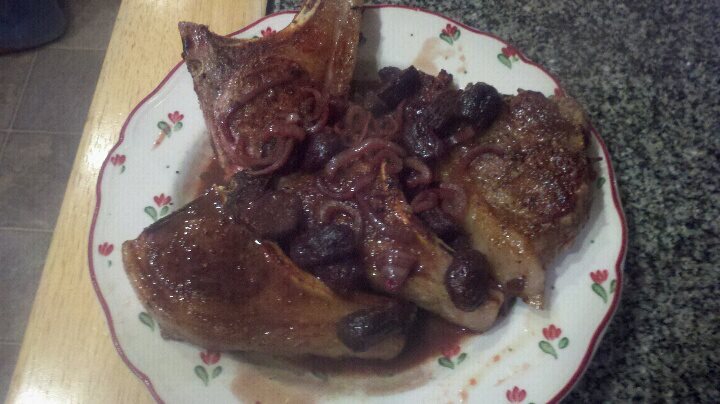
Next up was a whole spring lamb, which tipped the scales at 100 lbs. hanging weight. The lamb chops, pan-fried and served with a shallot, black mission fig, and red wine reduction would have been a bargain had I paid $40 per plate at the Metropolitan Grill.    

I am still saving two ample hind legs for a future special occasion.  When that day comes, I will marinade them in a mash of horseradish and roasted garlic, then roast it in a blazing hot oven to form a crust that will seal in the essential lamby juices. It will be just barely medium rare. 

As noted previously, both beasts came to our house via teenager 4-H projects.  Thinking about this gives me a bit of pause, as well it should when you are eating something that probably had a name.  Then again, I should probably pause even longer for those creatures of God raised in miserable agri-industrial conditions, such as the afore mentioned pork cutlet.  Politicizing my eating tends to curb my appetite and therefore I try to avoid it whenever possible.  Taken to its logical conclusion, political eating leads inevitably to veganism, and I’m sorry, but “that dog won’t hunt,” as my Cajun friends would say.  

Instead, I believe I will simply and contentedly continue down the path I am on, the one that frequently veers off grid, if not off the map altogether.  The 4H projects have been a triple word score win – not only has the meat proven tastier by multiples, but it has come at a fraction of the price that I would pay for a far inferior product at Fred Meyer.  And, some nice country kid got a wad of cash for her wallet. 

While this satisfies both the epicure and the miser in me, off-grid dining does not always mean cheaper.  Case in point was the Christmas Duck.  This fall I started procuring lovely chicken eggs from my new friend Carrie Little of Little Eorthe Farms (www.littleeorthe.org).  Carrie sets out a booth at my local farmers market (Proctor Street in Tacoma) with produce from the small family farm she operates in outer Orting with her husband Ken.  After a couple of happy egg purchases, I took her aside one gray Saturday morning and inquired as to whether she knew where one might procure duck eggs.  Her eyes got big, always a good sign. 

“Why, I have duck eggs right here,” she whispered.  She led me to the back of her booth and uncovered a clandestine stash of gorgeous Muscovy ovum. I purchased a half-dozen robust beauties at a dollar each and made a splendid Spanish tortilla that night with some leftover confit, sweet onions and Manchego cheese.  Yum!

While eating the tortilla, the thought came to me.  Where there are duck eggs, there must be ducks.  The next week I sidled up to Carrie and waited until there were no other customers around.  In hushed tones, I inquired as to whether they ever, you know, slaughtered any ducks.  “In fact, we have too many boys right now” Carrie cooed.   “We are culling the flock next week.  You are in luck.” 

Negotiations ensued and in a week I found myself driving out to Orting to pick up a 7 pound beauty, fully-dressed with webbed feet intact, never frozen.   I paid $40, a princely sum no doubt (and well in excess of supermarket prices), but one that ended up being worth every penny.  I carved the ample breasts from the carcass and separated the plump hind quarters.  Saving every sliver of yellow fat, I rendered a cup-plus of purified greasy golden goodness, which will be used for roasting potatoes and/or deep-frying pomme frites.   The carcass, wings, and neck were roasted golden brown and then added to a vegetable mirepoix, which made a stock deserving of its own armed guard. 

For dinner, the boneless (but skin-on!) breasts and thigh quarters were simply dusted with Chinese five spice powder and then pan roasted to medium rare.  If you are cooking a fattened duck yourself, one trick is to keep draining the fat as it cooks, or else you simply poach the bird and don’t get a nice mahogany-colored, crispy skin. Also, start with the thigh quarters – they need at least 15 minutes longer cooking time.  Even then, mine turned out a bit tough.  In the future, my duck thighs will be reserved to be rendered into a tender confit, which is another column all on its own.  Remind me to talk about duck confit with warm cabbage salad dressed with vinaigrette sometime. 

This philosophy, taken to its logical extreme, results in rolling your own.  Or growing your own as is the situation here.  A couple years ago I won the lotto and secured a community garden plot in a nearby city park.  The plot costs $35 a year, for which I get pre-season tilling and water.  I guess I could justify the expense by the hundreds of dollars I save on produce or the lack of pesticides, but those are secondary benefits.  Fresh grown crops simply taste better.  My 350 square foot plot cranks out an amazing abundance of veggies.  Too much for us to eat, a fact to which my neighbors will happily testify. 

I’m not sure at all if this off-grid thing is going to save the culinary world or not, but then again, that’s not the idea.  I lack sufficient resolve to be a food-hero.  Instead, my quest is to procure and prepare the best tasting food I can find at a price I can tolerate.  If that reduces my carbon footprint, or qualifies me for Team Locavore, I suppose that’s a outcome I can get in line with.  I still spend a lot at Safeway and Metropolitan Market and always will.  I’m not going to press olives into oil, churn my own butter or milk my own cows any time soon.  But if you have a pick-up pulled off to the side of the road and are selling chanterelle mushrooms for $5 a pound, you’ve got a deal.  Give me $20 worth. 

Lamb Chops with Black Mission Figs

Lamb chops (1-2 per person depending on size and appetite)

4 Tbs finely chopped fresh rosemary

Fresh Black Mission figs (2 per person, quartered lengthwise)

1 shallot, diced

Quarter cup rich beef stock

Red wine 

Pat chops completely dry and let sit at room temp for 30 minutes.  Dust with rosemary, salt and pepper.  Bring cast iron skillet to high heat and sear each side of the chops until nicely caramelized, a 3-4 minutes.  If thick cut, finish the chops to medium rare in 375 degree oven.  Remove from pan and keep warm.  Drain fat from pan.  Add shallots and cook a minute or so.  Add the figs and the red wine.  Reduce by half.  Add the beef stock and reduce farther.  The figs will melt a little.  Pour this mixture over lamb chops and serve immediately.  Crumble with gorgonzola cheese if you like that. 

Serve with mashed potatoes, braised chard and a stout red wine.  I would go with a sturdy Rhone. 

Happy New Year and Eat Well.

Posted in Uncategorized | Tagged , , | 1 Comment

Send Me the Bill

In a recent blog post, I mentioned how I actually learned to fly at one time in my life – not in a plane, or even a hang-glider, but just on my own, completely self-propelled.  One gentle reader asked if I would tell that story.  It’s a tough one for me to get my head around, not unlike nailing jello to the wall.  And the events surrounding it defy not only gravity, but any effort to formulate them into conflict, crisis and resolution.  But it’s a golden moment worth the attempt, so here goes…

It started with a note on the kitchen table.  Well not really, but sometimes you have to start the story in the middle, this middle being December 1980.  It was freaking frigid out there in Minnesota, with snow already piled up in huge mounds on the streets, both in Minneapolis where I was going to school and in Owatonna, where I still called it home.  The note on the table said “Call Bill McChesney” and there was a 451-xxxx number.  An Owatonna exchange. 

 Yeah right.  This was no doubt another in a long string of practical jokes perpetrated by the pater familias, my father.  This was the guy that fooled me into thinking the tuft of antelope mane in his overcoat pocket was in fact my Christmas guinea pig; the guy you had to watch like a hawk on April Fool’s Day because he would cook toilet paper in your pancakes.   

Except this time it wasn’t a practical joke. It was true. 

Now you may not know who Bill McChesney was, but in December 1980 I sure did.  And that he was waiting for my call at an Owatonna landline required a remarkable confluence of events.  Just six months previous, Bill had run an insanely bold and brave 5000 meter Olympic Trials race to make the ill-fated, Ruskie-boycotting U.S.Olympic team.  With a mile to go and time running out, he had stormed the field with a power surge that electrified his Hayward Field homeys into a frenzy in Eugene, where he was both a red-shirt junior Duck and a hometown hero, being a product of South Eugene High School.  Spent by his surge, he was overtaken down the stretch by legends Matt Centrowitz and Dick Buerkle, but Bill hung on gamely, lunging at the last moment for the third and final slot on the team.  The crowd, as they say, went wild. 

Oh, I knew Bill McChesney alright.

Or at least I knew of him.  Over the next two weeks we ran together twice a day, cruising in the crushing cold and crunching snow of Minnesota, developing a bond that would last until a dark, dank day in October 1992. 

It’s at this point of the story I need to backtrack a bit.  In December 1980 I was, as the saying goes, at the end of my rope.  Having accepted a scholarship to run track and cross-country at theUniversity of Minnesota, my days as a Golden Gopher had been particularly undistinguished, gold-plated at best.  I’d shown a few flashes of semi-brilliance, but by mid-way through my junior year I was bogged down in what could only be described as mediocrity.  Or worse.  My first race of the 1980 cross-country season, (held in a heatwave in Wichita in early September) saw me collapsing, blacked-out and puking in a heap with a serious case of heat exhaustion.  That debacle unhinged me and made something go horribly wrong, not just physically but mentally.  I was a psychic mess.  Once at least a decent enough runner who could hang with the leaders and score a few single digit points for my team, I turned overnight into an also-ran, pulling up the rear and falling off the back of the truck.  For somebody who had dedicated and defined himself by his running prowess since he was sixteen, I was embarrassed.  Embarrassed and, quite frankly, humiliated.  

So when I approached Bill for our first morning run, I did so with a double dose of humility.  Introverted by nature anyway, I didn’t say much our first few outings.  Bill on the other hand was chatterbox of the first degree, weaving yarns of European racing and Oregon life, exotic experiences to my Midwestern ears.  How the guy could keep up the patter the way he did while we carved out 10 mile runs through the southern Minnesota countryside was a wonder.  As for Bill, he couldn’t believe we ran in such conditions regularly.  “You mean it’s like this all winter long?” he would say shaking his head.  “I could never do it! Nobody on my team could do it…Well, maybe Alberto.”  Slugging me in the shoulder he’d shout “You are TOUGH, man.  One tough hombre.”  And he wasn’t above being cheesy, telling stupid jokes, or stories about skinny-dipping with nymphets on the beach in Nice, France.  One of his favorite things to do was to adopt an overblown television sports announcer’s voice (think Cris Collinsworth) and provide color commentary on our run as though we were duking it out down the backstretch of the track at Bislett Stadium in Oslo.  He would egg me on until finally, transported, I would bolt around the curve with McChesney in hot pursuit, the Norwegians going crazy as we drove in a mad sprint the final meters to a World Record time. 

Bill was in my little town down by the river because he had fallen madly in love.  About a year previous, broken down himself by injury and scraping the bottom of his own barrel, he had one night been lured out by his brother to a local Eugene watering hole for a 1950’s dance contest.  His hair slicked back and collar popped, he was struck by lightning.    Lightning by the name of one Nanci Westerlund, a blonde bombshell from (you guessed it)Owatonna who was attending theUniversity of Oregon as a grad student studying modern dance.  Captivated by Bill’s “unique” dance moves, Nanci paired up with Bill on the dance floor.  They won the contest and immediately fell for each other.  The electricity was such that it is amazing anyone in the building lived to tell. 

Which explains how he found himself stuck in frozen Owatonna,Minnesota in December when just a few months prior he was speeding around the great tracks of Europe, captivating crowds there with his infectious energy and fearless front-running.

One day, after a week and a half of running together, Bill and I finished up the last half-mile of a long run with an all-out sprint, one that saw him barely inch in front of me at the end.  Exhaling huge steam clouds and panting with our hands on our knees, Bill put a hand on my shoulder and looked up at me.  “Tell me,” he said between breaths.  “What happened?” 

Breathless, I paused a moment.  “What do you mean?” 

“For ten days you have been taking me to the limit in every run.  I just gave you everything I had and you stayed with me stride for stride.  But I never even heard of you before I came here.  What gives?” 

So, I told Bill my story of heat exhausted woe, of how no matter how hard I tried, how tough I was, something just happened to me now when I got in races.  How I’d get a mile in and suddenly my legs would turn to oatmeal.  How I was worried I would never be the same, let alone any better.

Bill looked up at me.  By now we had recovered some of our breath.  “That happened to me too,” he panted, going on to tell me how he too had suffered from heat exhaustion and struggled mightily for months after.  “It goes away, man,” he said.  “Don’t worry, you are going to be alright.”  He put his hands on my shoulders and looked me in the eye, his face just inches away from mine.  “You are going to be more than alright.  You are going to be great.  You know how I know that?”  I shook my head. 

“Now you know the secret.  Your body won’t let you kill it.  You are so damn tough, you can run yourself straight into the ground.  But now you know that even though you can run until you black out, you aren’t going to die.  Your body won’t allow it, it won’t let you”  He paused a moment.  “You can pull the ripcord, you can let it all hang out.  You can run free.  And you’ll be OK.  Not just OK, you are going to be great.” 

And with that, he pulled my sweat-soaked stocking cap off my head and threw it in a snowdrift.  “C’mon champ, let’s get some tea. It’s fucking freezing out here.”

We ran a few more days after that and then it was time for Bill and Nanci to head back west, back to Eugene where Bill was at home in the drip and drab of his Eugene. 

As for me, learning to fly didn’t happen overnight.  Bill flipped a switch for me, but the toggle took awhile to fully take effect.  Things got better for me almost right away, but I still had some serious uphill sections of road in front of me.  But I was better.  And I started to feel at ease.  Little by little I let it go.  And the more I let it go, the more free and easy it got.

Then, finally, it happened.  It happened like Scott Fitzgerald went bankrupt – that is, gradually and then all at once. 

On May 22, 1982, I woke up in the morning and I could fly.  Not metaphorically, literally.  As in, I could propel myself through space with virtually no effort, my feet not touching the ground.   OK, it looked like my feet were touching the ground, but they weren’t, not really. 

That morning I cut my shakeout run short after just two miles, worried that my newfound ability would disappear as quickly as it had come.  But it didn’t.  Later that afternoon, I knocked a minute and a half off my previous best 10,000 meter time and almost effortlessly beat a field of excellent runners for the Big Ten Championship.  The next day, I doubled back in the 5000 and again lopped dozens of seconds off my previous personal best, being beaten in the process only by Jim Spivey and Tim Hacker, two men who would go on to distinguish themselves as Olympians and international stars.  Two weeks later I was an All-American. 

After that, I was on my way.  To be sure, not every day was one where I could fully take flight, but I had more good days than anyone deserves to have.  Some of those days were even great.  Some days, I even flew.  Many days in fact, and the memory of being able to do that lives on in my body and in my bones to this moment.   For a thick-legged kid from the flatlands, I did reasonably well.  Not the best, not by any stretch, but I did well enough to rank in the second fifty runners in the world in my event. Top 100 doesn’t sound like much, but it meant something to me then, as it does now. 

As for Bill, he had his share of good and great days as well.  Man, when that guy was on, he didn’t just fly, he was a fighter jet.  There were few people in the world that could stay with him.  Ultimately, he hammered out a 5000 meters in 13:14, which at the time stood as the U.S. Collegiate Record and was agonizingly close to the World Record.  At least three times he was ranked among the top five in the world at 5000 meters.  His time still stands as the UO school record, which is no slouch given Oregon schooled the likes of Alberto Salazar and Steve Prefontaine, among many other champions.

As with all champions, Bill had his own Achilles heel, which ironically in his case was actually his Achilles heel.  Born with fragile tendons, Bill nevertheless flew close to the sun and then, when inevitably his wings melted, he crashed.  Mortals like us can play with the Gods only so long, but eventually we are fucked.  On a rainy afternoon in late October 1992, his running career prematurely cut short and now long over, Bill’s small pick-up truck hydroplaned (ironically flying again I suppose, but in a very bad kind of way) on a busy coastal highway and he spun out into an oncoming semi-truck. 

Bill was just 33 when he saw the black lights.  That the world is a little bit less for me without Bill McChesney in it bears mention.  If you never saw him run, you missed something pretty special – the sight of a human being in full flight.

Here is a video of Bill with some great clips of him flying.  At first glance, it looks like he is running like normal mortals, but if you look really close, you can see that his feet don’t actually touch the ground.  He’s flying…

bill_mcchesney_jr.html

Now I am getting old and I can’t fly any more.  Still, I have my memory and my imagination, and on a crisp fall day with the sun slanting low, memory serves.   

Bill’s Granola

It seems odd to wrap up this story with a recipe, but that’s the format of this column and I’m sticking to it.  This recipe actually came from Bill’s mother-in-law, Nanci’s mom Mary Lou Westerlund.  Or at least that’s where I think it came from.  I remember Bill loved it and we had it every morning after we ran together.  I still make this regularly and the recipe is in my card box with the title “Bill’s Granola.” If you start levitating after eating this, don’t worry – it’s natural.

3 cups whole oats

1 cup chopped nuts

1/4 cup honey

1/4 cup melted butter

1.5 tsp cinnamon

1/2 tsp salt

2/3rds cup raisins

Mix all ingredients except raisins and bake in an ungreased baking pan @ 350 degrees for 25-30 minutes, until well toasted.  Add raisins and mix well. 

Fly.  Bon Appetite.

Posted in Uncategorized | 13 Comments

Get What You Need

What do you really need?

The question came up this week when my friend Chef Gordon Naccarato posted a question on his award-winning Pacific Grill Blog (http://blog.pacificgrilltacoma.com/)  about sweet potato casserole with marshmallows:  Necessity or abomination? 

It got me to thinking about Thanksgiving necessities. For example, I’d be delighted with a large stuffed salmon over a turkey, especially accompanied by a largish platter of Penn Cove Selects as an appetizer.  Pecan pie, cherry, or key lime could sub in for punkin and I’d be fine with that.  Stuffing?  Make mine bread, cornbread, oyster…it’s all good to me.  Veggies?  Brussels sprouts are the tradition around my home, but I’m good with lots of options there. Sufferin’ succotash anyone?

If you’re like me (and I know I am), it’s all good.  Still, there is one Thanksgiving dish upon which there can be no discussion, no compromise, no negotiation.  One dish so modest it barely merits mention in most cook books, glossy periodicals or televised food porn.  You’ll find no featured centerfold in Gastronomica. 

That’s right, mashed potatoes and gravy. 

If you aren’t planning on serving this dish on Thanksgiving, don’t bother inviting me over.  Not even opening that bottle of Chateau d’Yquem could make up for such a glaring omission. 

Ample opportunities for trial and error have helped me develop what I think to be the optimal method of preparation for this dish, which (while humble) can soar on wings of ospreys and/or eagles if you do it right.   “Sure,” you are now saying.  “Anybody can make mashed potatoes and gravy.  EVERYbody makes those.”  And it’s true, everybody can make them and seldom are they really bad, unless the potatoes came out of a box and the gravy from a packet or can. 

Still, like many things in life, a little planning and care can transform the prosaic into poetry.  In this case, poetry on a plate. 

Here goes:

Mashed potatoes

As with everything, it starts with the ingredients.  You need good potatoes.  That 10 lb. bag of moldering russets on the basement stairs that cost 10 cents a pound isn’t going to cut it.  I like Yukon Golds or Yellow Finns best, but am also fond of large reds.  Either peel them or leave the skins on, whatever you prefer.  I happen to like the reds with skin-on andYukons peeled, but that’s me.  Cut into chunks and place in a pot big enough so that you can get a couple of inches of water over the potatoes, no crowding.  Fill the pot with cold water.  Notice how cloudy the water gets?  Now drain it, that’s nasty starch you don’t want.  Refill with cold water and salt very liberally.  Be bold.  Some say salt it enough that the water tastes like seawater, but I don’t go that far.  I use kosher salt, but then that is all I have in the house. 

Bring the potatoes to a hard boil and cook them until they are well done and very soft.  A fork should easily pierce them without resistance.  Once fully cooked, drain the potatoes in a colander (reserving at least 1-2 cups of the cooking water) and return potatoes back to their pot.  Put the pot over medium heat and cook dry for a minute or two.  Don’t scorch.  This is a step that I omitted for decades, but it is key.  You need to get every bit of the liquid you can out of those guys. 

Once they are dry, its time for the mashing.  Some are steadfast in their belief in the ricer as theOne True Way, but I believe there is more than one route to salvation.  Personally, I am good with an old fashioned potato masher.  I don’t like my taters too creamy or uniform and the masher performs admirably in this regard.  Growing up, we used a Sunbeam electric beater and while I am generally disallowed from casting aspersions on my mother’s cooking, we part ways on this particular technique. 

Now that you have your potatoes cooked and mashed, it’s time for imagination and the artistic impulse to take over.  You could add some milk and butter and call it a day, but that would be the Readers Digest version of mashed potatoes.  Sour cream (neither lite nor fat-free, this is not the time for healthy options) is a traditional option, but this is Thanksgiving after all and time to go for broke.  If not now, when? 

For me, going for broke means sautéing some chopped garlic in butter and then adding a largish splash of heavy whipping cream.  Warm that mixture and then put it into the mashed potatoes and mix thoroughly. 

If this concoction is insufficiently slutty for you, you can tart it up even further.  Chives are good, but I prefer a handful of chopped Italian parsley.  Once I added some nubbins of sautéed lobster mushrooms.  This, I highly recommend.  Chanterelles, now in season, work nearly as well. 

So, let’s review.  Good potatoes, salt the water, cook thoroughly, mash roughly, add liquid, accessorize to taste.  Easy peasey.  Now we’re cookin’.

Gravy

This is an area where my tread needs to be light.  As it turns out, my mother is very sensitive about culinary criticisms contained in my little essays here, regardless of whether the slight is real or merely perceived.  So, before I fire up the gravy train, I am required by family law to make the following declaration:  my darling mother makes the world’s best rhubarb pie, potato salad and snickerdoodles.  Hands down no question. 

Now that we have that out of the way, she makes gravy wrong.  If you make gravy by mixing some flour with water, stock or other liquid and adding the raw slurry to pan drippings you are making your gravy incorrectly.  Sorry Mom. 

To make a perfect, velvety, rich gravy you need to roux.  Here are the basics:

4 cups turkey or chicken stock (preferably homemade)

4 tbs skimmed turkey fat, butter or combination

Quarter cup flour

Warm the stock.  Put the turkey/butter fat into a saucepan large enough to hold all the gravy and warm to medium.  Stir in the flour and cook on low, stirring regularly while the roux foams until it becomes a nutty brown, probably 10-15 minutes.  Add the warm stock and some of the reserved potato water.  Whisk vigorously to remove any lumps until the gravy thickens.  Season expertly and you have the perfect gravy. 

If you are cooking a turkey, you can add any carving juice that comes out of the bird.  Also, scrape up the caramelized brown bits from the bottom of your roasting pan with some white wine and add that as well.  The result is virtually fool-proof and magically delicious. 

It’s true, you can’t always get what you want.  But if you serve mashed potatoes and gravy, you’ve got … ah, hit it Mick…


Happy Thanksgiving.  Now go for a walk.

Posted in Uncategorized | 8 Comments

Great Big Empty

Gillette, Wyoming might well be the worst town in America, its sole redeeming virtue that you can buy a fifth of cheap Canadian from a liquor store with a drive up window.  Because God Knows, the last thing you want to do in Gillette is to get out of your car to buy your booze.

Gillette has gas.  Literally.  One of the main industries in the area is drilling for methane, which is an industry that stinks.  Again literally. As a result of drilling, the methane in Gillette leaks into residential wells in sufficient quantities that you don’t want to light a match while you are sitting on the commode, so the story goes. 

No lie.  I can’t make this stuff up. 

A while back I actually spent the night in Gillette in what was perhaps the worst motel in town, a dump so nasty it gives landfills a bad name.  Let’s take a second to review.  The worst motel in the worst town in America.  You do the math. 

So you might understand when I say I woke up the next morning a tad grumpy.   The Mustang Motel, I should have known better.  My first room had not even been touched by housekeeping.  The wastebasket next to the lumpy (and unmade) full-size bed contained half a dozen used condoms and there was a half-rack of crushed Pabst cans on the side table.  Party on Wayne.

When I went back to the office (where the clerk sat behind bullet-proof glass), and asked for a new room, the guy rolled his eyes as though I had just asked for Egyptian linens and a humidor packed with Cuban cigars.   

Damn high maintenance tourists. 

The night previous I had stayed in Livingston, Montana.  In comparison to Livingston, Gillette might as well be on the dark side of the moon.  At Livingston’s Murray Hotel, a mere block from the Yellowstone River, I slept deep and dreamless on a fluffed featherbed with a deep down comforter and watched pay-per-view on a large flat-screen TV.  Dinner was at artist Russell Chatham’s Livingston Bar and Grill (now shuttered, sad to say) and included a dozen Kumamoto oysters and a monster lamb shank (braised until falling off the bone) that was nestled cleverly into a bed of creamy polenta.  Dinner was finished with warm pear crisp.  The oysters were washed down with a couple of glasses of steely Loire Valley Muscadet, the lamb with a bottle of St. Innocent Pinot Noir from Oregon.  With dessert there was scotch, a splendid and smoky single malt from the Isle of Islay. 

In Gillette, not so much on the food front.  Unable to find an open restaurant at 9:00 pm, dinner was a greasy bag of Burger King slop (have it your way my ass), washed down with the afore mentioned Canadian mixed into a super-sized Diet Coke.  As if matters could get any worse, the game on TV found the Raiders being beaten by the Patriots on the infamous/bogus “tuck rule” call that magically transformed a Tom Brady fumble into a meaningless incompletion.  Upon further review, instant replay sucks. 

Needless to say, I was out of sorts. 

The next morning I got up early and went for a run to try to shake off the slag.  Two steps out the door of the Mustang, I knew there was trouble.  A biting wind blew out of what could only have been the north and angry dark gray clouds scudded at barely rooftop.  Clouds with an attitude.  Clouds that had just been paid and were fixin’ for a bar fight.  It was January, which in Gillette can only mean bad things.  Believe me when I tell you I was not in the mood to be snowed in and stranded in Gillette, Wyoming. 

After being nearly eaten by an unleashed pit bull protecting the turf around his double-wide, I snapped the run off short, threw my bag in the car without a shower (as if) and hustled Roy, my trusty yellow Labrador, into the back of the Outback.  Pulling out of the Mustang parking lot, I thanked heaven for all-wheel drive.

We boogied out down the arterial past a couple of depressing unoccupied strip malls without so much as a Styrofoam cup of Folger’s Mountain Grown.  A few weeks previous I had lost a crap job and in the process several other things of far greater value.  I was in no mood, believe me. 

Roy and I drove straight past the Interstate entrance ramp and in a quarter mile came to a T in the road.  Frozen snow spit on the windshield while the intermittent wipers smeared the freeze.  Roy groaned once and laid down on his cedar chip bed in the back, chagrined no doubt by the absence of a morning tennis ball toss. 

Stopped at the intersection, we idled.  Across the way, an impossibly long freight train clattered past in front of us, coal cars dusted with snow.  I looked right and saw nothing.  Looked left and saw more of the same.  Had there been tears in my eyes I would not have been embarrassed.   But I was bone dry. 

Then, this song came up on the shuffle, completely by chance. 

Roy and I sat at that intersection stopped with my foot on the brake and listened all the way through.  Four minutes give or take.  At the end of the song I looked at Roy in the rearview mirror.  “Well, boy” I said through tight lips, “whaddya think?  Which way?”  The dog said nothing, his brown eyes staring back calmly, without emotion. 

We turned right and left Gillette in the rearview mirror. 

Lamb Shanks Braised in Red Wine

Rub lamb shanks liberally with a mixture of fresh chopped rosemary, minced garlic, paprika, salt and pepper.  Cover with plastic wrap and refrigerate overnight. 

In a deep pot (I use a large Creuset enameled cast iron beast) brown the shanks in hot olive oil turning until they are well browned.  Remove from pot. 

Add chopped onion, leek, carrot garlic, and celery (in French this is called a mirepoix) to the pot and cook until softened.  Add about 2 Tbs tomato paste to mirepoix and cook until it gets clumpy, about 2 minutes.  Add red wine (at least a half bottle) and scrap up brown bits from the shanks.  Replace lamb shanks in the pot and add more red wine (and perhaps some good beef stock) until the shanks are at least half covered with liquid. 

Cover and place in 300 degree oven for 3 hours. 

Serve with creamy polenta or garlic mashed potatoes and sautéed spinach. 

(Author’s Note:  You will never find this dish in Gillette, Wyoming)

Bon Appetite.

Posted in Uncategorized | 4 Comments