Anchovies on the Brain

In addition to my fondness for offal and meat with a “gamey” quality (not just duck and lamb but elk, deer, pheasant, and grouse…that sort of thing), my culinary proclivities include the little fishies: anchovies and sardines. In fact, two of my most favored dishes, puttanesca pasta and Caesar salad, feature anchovies prominently in their preparation. Neither dish would be what it is without them.  

So I was properly alarmed (upon returning to these States from a trip to the Adriatic) to learn of a recent mass die-off of a large school of anchovies in the Santa Cruz Harbor. According to news reports, they fished some 11,500 POUNDS of dead anchovies out of the drink at the marina. That is nearly SIX TONS of anchovies. And that is just what they were able to net. Because anchovies decompose so quickly, some multiple of pounds beyond the 11,500 were irretrievable; they just fell apart, and there was nothing to do but watch them sink and wait for the waves and tides to wash them out to sea. While I missed the event by just a few days, I can nevertheless imagine the smell of several TONS of anchovies rotting in the water. Even in my olfactory imagination, the odor coats the back of my palate. Ish. 

This was not the first time anchovies have died en masse in the harbor at Santa Cruz. Similar sudden deaths, while not common, have occurred often enough that measures to prevent them have been implemented. The last die-off happened 10 years ago, in September of 2014, and that event made this one look puny in comparison. In 2014, they trucked some 120 TONS of dead anchovies to the dump. Yikes. That could have kept Paul Newman in the Caesar salad dressing business for decades. 

Thank heavens, the administrators down at the Harbor are now prepared for what appears to be a decennial event; they no longer truck the fetid fish to the county landfill but instead ship them to local farms, where the anchovy corpses are put to good use as fertilizer. A reasonable solution has been found to what would otherwise qualify as an unmitigated disaster. Still, I would not like to be stuck in traffic behind a dump truck loaded with a couple tons of them. 

If you are like me, you are now wondering how this happens and why. As with much of life, there are no good answers to these questions. Well, technically we do know the how: every so often a large (very large, as it happens) school of anchovies gathers at the mouth of the harbor and somehow communally decides that it would be a good thing to enter a narrow channel that has been dredged to dock a few dozen boats. The marina in Santa Cruz harbors vessels that range from mom-and-pop commercial fishing boats that seek Monterey Bay salmon, crab, and rockfish to sailboats and a few personal run-abouts. It’s a quaint, cozy cul-de-sac of a waterway, barely as wide as an LA freeway. The why is a little less clear. Whether it’s that they are chased into the marina by predators (apparently I’m not the only stalker that feeds on them) or it’s a case of bad advice from a Fearless Leader, the fish suddenly engulf the marina. Before they can realize that a terrible mistake has been made – a decidedly lethal mistake – they are dying. Turns out that hundreds of thousands (if not millions) of little fish use up an alarming amount of dissolved oxygen when they are schooled gill-to-gill. The open Pacific Ocean is a large place that easily accommodates the O2 needs of an anchovy school, but it seems that a small-town marina is not. Before they even know there is a problem, the oxygen plummets to a level that does not sustain life, and scores of fish expire within moments.   

Having seen this event repeat itself with some degree of regularity, the harbormasters have acted by installing an oxygenation system, which they fire up when a school of panicked (or perhaps misinformed) anchovies enters the waters. This device has managed to prevent smaller-scale piscatorial suicide missions over the years, but a million or two little fishies can and do overwhelm the system. It’s a shame, no doubt, but I don’t think much more can be done about it, short of filling in the marina. Life is like that; sometimes there is no reasonable recourse but to live with the occasional tragedy.   

While there is not much more that can be done to prevent future ancho-pocalypses, perhaps there is something to be learned. My mind immediately endeavors to translate an event such as this into an instructional metaphor that might help avoid a similar result, or at least provide a glimmer of understanding. I’m not exactly sure what that metaphor might look like for you, but I’m sure there are several ways of interpreting events like these. Let’s face it: on matters of life and death on a macro-scale, I am an unreliable narrator – better you should petition Dostoevsky, Faulkner, or the late, great Jim Harrison. So feel free to take with ample grains of salt my perspective, which is that breathlessly following the crowd can lead to physical, if not spiritual, suffocation. Now, I’m not arguing against socialization here. Like anchovies, humans clearly benefit from communal living. Still, any community can and does make decisions that are Horribly Wrong, which our recent election has abundantly illustrated. Another take is that, despite our many machinations to counter it, the Grim Reaper will catch up to us all – some day, some how.  Either you get eaten in the open ocean by a hungry pelican diving on you from the inscrutable heavens above, or you suffocate while taking refuge in an over-crowded waterway meant only to float a few boats and not to sustain your life. Either way leaves you just as dead.  

In the end, it all ends. Meanwhile though, we can and should eat, with mucho gusto if possible.   To counter-balance the decidedly downbeat nature of this missive, I am rewarding my gentle readers with not just one but TWO anchovy-based recipes, both of which have been time-tested and tweaked over the decades. Eat Well.  

Caesar Salad Dressing 

Is there a better salad than the venerable Caesar?  While the Wedge, Chop, or a bowl of just-plucked spring greens drizzled with a perfectly balanced vinaigrette have their place, the Caesar would be right up there if I had to choose just one. The complementary flavors, combined with a pleasurable crunch, are both satisfying and inspiring. Over the years, various chefs have morphed the Caesar into something that can, at times, barely resemble the original, which was invented by the Italian immigrant Caesar Cardini in Tijuana, Mexico. Mine sticks close to Cardini’s recipe and goes something like this: 

½ cup grated parmesan cheese (go Parmigiano Reggiano) 

3 large cloves peeled garlic 

2 tsp Dijon mustard 

3 anchovy fillets (this is a starting point; you can do more or less, and I recommend more)  

2 egg yolks 

Juice of 1 lemon 

3 dashes hot sauce of choice (my house pour is the Cholula brand)  

2 dashes Worcestershire sauce 

Salt and pepper to taste 

1 cup good EVOO 

Put the first nine ingredients in a food processor and pulse repeatedly until the solids are well chopped and the egg yolks are creamy. With the motor running, add the cup of EVOO very slowly, barely a drop at a time at first, then in an ever-so-thin stream. The goal is a thick-ish emulsification rather than a runny dressing, which is what you would get if you just whirred it all together in the processor. Learning how to make an emulsification is part of the joy of the kitchen and should be part of every home cook’s repertoire. You can emulsify a sauce by whisking it by hand, but this can require wrist strength of professional proportions. I do whisk my hollandaise by hand, but there the heat assists the process. For a cold dressing like a Caesar, the food-processor cheat is fine in my book.  

Once you have the dressing made (and it will hold in the fridge for a couple weeks at least), you can go lots of directions. I often split a smallish head of romaine lengthwise and char it briefly on a hot gas or charcoal grill, just long enough to make marks. For the croutons, I like to get mine well-toasted in a 350-degree oven and then smash them into crunchy crumbs. For years I made the typical bite-sized square cubes, but the crumbled treatment they give them at Ethan Stowell’s How To Cook A Wolf restaurant in Madison Park, Seattle has persuaded me that this is the way I like them best. Just put some good cubed bread in the oven, roast until DGB (delicious golden brown), and break them into a crumble with a rolling pin.  Now you will have delicious crunchiness in every bite of your salad. Drizzle the dressing over the grilled romaine halves, top with crouton crumbs, add more grated Parmigiano Reggiano and dig in.   

Pasta Puttanesca 

If it weren’t for the anchovies, this dish would be vegan, but I’m afraid you can’t omit them and still call it puttanesca. “Puttanesca” refers to the dish’s association with Italian brothels, specifically those in Naples. The exact origin is debated, but it clearly has some connection with prostitution – which is fine by me, no judgement. Some say the smell of the cooking sauce wafting through open doors and windows was an enticement for paying customers to enter. Others say that the “quick and spicy” nature of the sauce was akin to the experience one might expect in such an establishment. 

My own experience with sex workers (Italian or otherwise) is decidedly lacking, but if this dish was included in the transaction…well, you never know.  Here’s my take: 

3-4 (or more) cloves of good garlic 

3 (or more) anchovy fillets, canned in olive oil 

2 tsp crushed red peppers 

1/2 cup chopped kalamata olives 

2 Tbsp capers (chopped or whole)  

Large can whole tomatoes (preferably real Italian ones from San Marzano), crushed by hand 

Parsley, oregano, and basil, fresh if you have it 

Chop the garlic and set aside. Roughly chop the anchovies, mashing them with the blade of a chef’s knife until you have a paste. Combine this with the garlic and chop some more to mix them well. Add oil to a pan set on medium heat and add the garlic/anchovy mixture. Add the crushed red peppers and sauté a few seconds. Add the crushed tomatoes, kalamata olives, and capers. Bring to a simmer and turn down to low. Add the herbs. You don’t need to cook this all afternoon; just a few minutes does the trick. While you are assembling the sauce ingredients, you can cook your pasta, which can be spaghetti, linguine, penne, rigatoni, or whatever you want. Add a little of the pasta water to the sauce, stir well, and then add the al dente pasta to finish cooking. If you need a protein with this, you could add a tin of excellent tuna or some sliced, cooked sausages.  Puttanesca is a dish that really only takes the amount of time necessary to cook the pasta, assuming you have your mise en place together.   

Enjoy!  

I could not think of a good music video to pair with anchovies, but watching the recent SNL 50th anniversary special brought this bit to mind. I laughed my 16 year old head off when I saw it originally, and it is still funny, at least it is to my decidedly warped sense of humor.

 https://www.youtube.com/watch?v=gpgpiawOFbg

Posted in Uncategorized | Tagged , , , , | Leave a comment

riverrun

The river leaves

Not knowing where it is going

Or how it will get there.

It runs

Blind-folded, bluffing

Over sticks and stones

Then arrives

The moment it leaves

Having learned nothing

Photograph credit: Joe Nabbefeld

Posted in Uncategorized | Leave a comment

Cheers Revisited

Well, it has been just over a year since I took the plunge of drastically moderating my alcohol consumption and I am checking in with a progress report. Aside from the “special occasions” of vacations, I have strictly adhered to my 5-dry days a week practice and more-or-less responsible consumption on the wet days. The cardio issues that prompted this modulation seem to have resolved themselves in my favor, and my life-long high BP has now settled in at a normal-ish 115/80. Cravings for alcohol have gone from being barely hanging in there until the Friday afternoon uncorking to being able to envision complete abstinence (in the somber event that such sobriety should be necessary). I have shaved off a couple pounds but not as many as I thought would come off by eliminating 30 drinks a week from my routine. My memory and overall mental acuity are marginally better and physiologically I feel peppy, bright-eyed and bushy-tailed (not that my tail was less than bushy before).

While the goal of a more efficient ejection fraction was achieved in a mere six weeks, I hoped for a bit more benefit for my efforts, especially in regard to the waistline. Now retired from the workaday world, drinking to achieve anxiety relief is now a non-issue and I seem to have broken the lazy habit of needing a glass of booze in my hand to feel at ease. To be honest, a tumbler of tonic, lime and ice cubes achieves the same effect that adding a jigger two of gin used to have. Also, non-alcohol beer options are now ubiquitous and surprisingly satisfying (although I am admittedly no beer connoisseur). The one downside is that a mere four drinks now leaves me with muddled hangover that lasts past noon, especially if one of those drinks was a largish martini. Prior to moderation, four drinks was a good start for me. No more.

If you missed it, my original post is re-blogged below. If you are pressed for time, I highly recommend skipping down to part where I share Jim Harrison’s musings on alcohol moderation.

Posted in Uncategorized | Tagged , , , , | 3 Comments

All Knotted Up

We were floating the river, the Mighty Mo (Montana’s Missouri River) in the usual places. I was seated in the bow while my friend the Birddog occupied the stern.  While neither of us is from anywhere close to Montana (where the headwaters and most of the best parts of the Missouri are located), we had been fishing this river on annual sojourns long enough to know what was coming around the next bend.  

In the middle and on the oars, as usual in those days, was the highly capable Captain Mike Guerin, our “Mo Better” guide. Back in those olden days, Mike would take the summer off from his usual activity (guiding serious anglers for tarpon, permit and bonefish in the Florida Keys) to float dry fly-fishers down the Montana section of the Missouri in search of giant browns and rainbows.  Preferably top water feeders showing their heads.  Even more preferably, gathered in pods of a dozen or more. Of course, this scenario plays out only so often due to the existence of more variables than an advanced calculus equation. Such as: bug hatches, cloud cover, water levels and temperatures, barometric pressure, wind velocity, the numbers of like-minded anglers, time of day, etc. etc.  Some days they are feeding manically, poking their heads up and down out of the water like horny prairie dogs. Other days an upwind fart puts the fish down.  Like life, you never know.

This particular summer day was bright and sky blue with a beaming and beautiful sun – horrendously bad conditions for feeding trout dry flies, although it is good for the “bikini hatch”. Trout far prefer cloud cover when it comes to surface feeding, which makes sense when you think about it. Their main predator comes at them from the skies, aliens from above; another galaxy. Ospreys, eagles, pelicans, terns, gulls and numerous other birds feast on top-feeding trout, even more so when they can get a good bead on them, as they can on a sunny day.  Hence, when the sun comes out, most trout beat it for the bottom to forage for tiny bug nymphs, while staying out of reach of dive bombers.  They wait for the cover of clouds before exposing themselves on the dangerous surface.

Like most mid-summer days in Montana, complications ensued. As the sun rose in the sky toward its zenith, the wind kicked up. Wind is a near constant companion on the Missouri River between Helena and Great Falls (that’s as specific as I am going to get in terms of sharing our location) but it is more of an issue when the sun is out and it starts howling at 20mph or more.  That’s good kite flying weather but it makes casting a weightless fly with a floating line and a 5x tippet nearly impossible. At least for me. Also, a good wind beats down airborne bugs. Floating bugs being pretty much the whole idea when it comes to dry fly fishing, wind is a four-letter word. And not one of the good ones.

“Boys, button up those flies,” Captain Mike chattered from mid-boat.  “We are going to row downstream awhile to see if we can get away from this wind.”  Birddog and I reeled in and secured our flies while Mike started to put his back into the oars. 

A break in the action like this affords the angler a few moments to take care of some basic house-keeping. This is a good time to check your hook, add some floatant juice to your fly (not that one!) and examine your line for nicks, cuts and abrasions. Not to mention lather up with sunscreen and sip that warming beer in the cup holder by your knees. You would be amazed at how much can happen when nothing is happening. A break from actual angling does not mean you doze off. Well, not always. While there is no crying in baseball, fishing does allow for naptime. 

While examining my own leader and tippet, I found bad news. “Uh-oh,” I muttered from my place in the bow. “Looks like I have a few wind knots here.”  Wind knots may not seem like a big deal and in reality they really are not – most of the time.  Knots in the leader won’t prevent you from catching a fish, they prevent you from landing them. They occur most often while casting in windy conditions where the slender leader and flimsy tippet get blown out of sync as you flip line back and forth, looping through itself and tying what is basically an overhand granny-knot. Cast that line a few times and the knot tightens down into a death grip that can’t be loosened. These knots are miniscule and you really don’t even notice them until the line is carefully examined. They have no effect on casting, spooking fish or any other of a million things that go wrong when stalking wild browns and rainbows. The problem is that they create a weakness in the line that is exposed when you have a fish on. Even a medium sized rainbow or brown trout, while wiggling and leaping out of the water will snap a knotted leader.  Thus, I was duly concerned to find my leader thrice compromised. My next strike was bound to be a fish of epic proportions, which would be assuredly broken off with even a modicum of pressure.

That’s when Captain Mike audibly guffawed behind me. “Wind knot!?”

“Yeah, see,” I replied, swiveling my seat to face him and showing him the compromised leader.  “There are at least three.” I paused, realizing that I had just made more work for my devoted guide, who was already otherwise occupied skippering our vessel. “No worries, maybe I can pick them out with my nipper needle.” I’ve never heard a guide say it, but fixing knotted lines has to be one of the worst parts of the job.  They will row a drift boat into the wind, free ensnared anchors, tie on new flies every hundred yards and perform all manner of other tasks without a word of complaint. But throw a knot or kinky tangle in your line?  That’s when their shoulders droop. I know, I’ve seen it happen. A hundred times. 

“Don’t worry about it, I will put on a new leader when we get around the next corner,” Mike replied amiably enough. Then he added the crushing words, delivered with a chuckle. “But that’s not a wind knot, it’s a casting knot.” 

Ugh. It’s amazing how replacing one small word changes everything. As a wind knot, the chaotic, contrarian universe was simply having its way with me.  Shit happens, as the young people say. But as a casting knot? There the onus was squarely on me.  Me and my own personal brand of ineptitude. Operator Error. Oh the Horror and Humiliation.

Chastened, I swiveled my seat back to the front facing position and proceeded to pick at the first knot with the needle end of my line nippers, which is basically a glorified (and often expensive) nail clippers.  I picked out the first knot with relative ease and went to work on the other two.  Mike pushed the boat against the wind and Birddog nodded off in the stern, his line (not to mention his conscience) free from such amateur behavior. After about 5 minutes, I finally loosened knot number three and freed my dainty leader from its ensnarled state..  Once restored to its factory settings, the kinks left in the once knotted line would straighten themselves out as soon as I hooked a 25” brownie. Which I would skillfully bring to the net using finely honed skill and wiles, not to mention a knotless leader. Did this actually happen?  Well, it has. 

Parked now in my writing studio, it occurs to me that the whole wind/casting knot deal functions as a sort of literary metaphor, if not a life lesson. Life can throw a lot at you – much of it outside your control. The universe, lacking a mind of its own, exerts its will without prejudice.  Some days you win, some days you lose. Alternatively, we humans blame a lot of the bad stuff that happens on the feckless universe when in fact it’s the result of operator error and/or gross ineptitude. Sitting here now at the relatively safe harbor of my keyboard, it strikes me that being able to discern the difference between situations caused by an uncaring cosmos and those caused by our own unforced errors is what brain doctors would call “mighty important”.  A healthy dose of self-awareness can help avoid a lot of the knots in your life. If you are lucky enough to have a guide who will remind you of the difference between a wind knot and a casting knot, you are a fortunate son.  If they do so with energy that is at once calm and assertive, you owe them an extra big tip. 

Still, we can’t flagellate ourselves for every knot we tie in our life lines. Often the best we can do is get out the nippers and needle and pick at that knot until it loosens. Do that enough and you gain the experience you need to tell when you can get the knot out or to chalk it up to a waste of time and just cut the leader. Mastering the skill of untying knots, while esoteric on its face, is a handy competency for life.

Another path is to try to not make the same mistake repeatedly. A couple of days after the wind/casting knot disaster, we were fishing into yet another howling wind. In one hole in particular, trout heads were poking up all over, only to vanish if the boat was pushed too close. To entice one to bite, you had to make a long, accurate cast. Into the wind. Which as it turned out was about 10 feet further than I could heave my line. Captain Mike’s voice behind me kept saying “punch it. Harder. Harder.” I was trying, but my casting was like Mike Tyson trying to punch smoke.  The harder I tried, the more failure I piled into my already fragile psyche. 

Finally I tried something I had read about, and practiced a little but had never really tested under actual fishing conditions: the Double Haul. Sharing instruction on the double haul is beyond my modest capabilities but suffice to say that it is a method of increasing line speed (and therefore distance) by adding a short tug to the line just as you are going to launch it. A single haul is accomplished when you are throwing the line forward, while the double requires two perfectly-timed tugs: one on the back cast and the other a moment and a half later, on the forward throw. Accomplishing the Haul (uno or doppio) requires more finesse than brawn (yet another life lesson here, I’m full of it today). When executed with grace and dignity (not to mention timing), the line cuts through the wind like a sharpened scythe through dry hay. Luck being with me at this exact moment, I double hauled as though my life depended upon it and stunned myself with a perfect execution.  My line loop was tight, launching the leader, tippet and fly through the wind as the proverbial hot knife through butter. The caddis imitation I was fishing landed three feet in front of a fish nose and the current did the rest, delivering the twisted elk fur and feathered hook straight to the waiting fish, who gobbled it hungrily.  My rod doubled over and the line straightened. Fish on!

“Nice one!” shouted my mentor in the middle seat. “Nice double haul!”  Then a pause before, “Where has that cast been all week?” In a fishing boat, as in life, a balance must be struck. For every compliment an equal and opposite criticism must be levied.  It’s fishing physics. 

All I could do was shrug. I carefully worked the fish over to the boat, where he was netted by Captain Mike. Smiles and photo ops ensued. A chunky buck rainbow, he measured 19 inches from snout to tail – large but not the behemoth he would be next summer. Still, he fought as though he belonged in the heavyweight division.   

I could have tried that cast a dozen more times after that and not come anywhere near the proper placement. If my skill level for fly-fishing matched my enthusiasm, I would be known far and wide. Anglers would whisper my name in hushed tones on the banks of famous rivers. I might even have a fly named after me. But such is not the case. My casting skills, barely proficient for such technical angling, often leave me coming up short. Still, every once in awhile, I get the job done, even if it is just by a whisker.  But that’s enough, even if just barely.

Grilled Rainbow

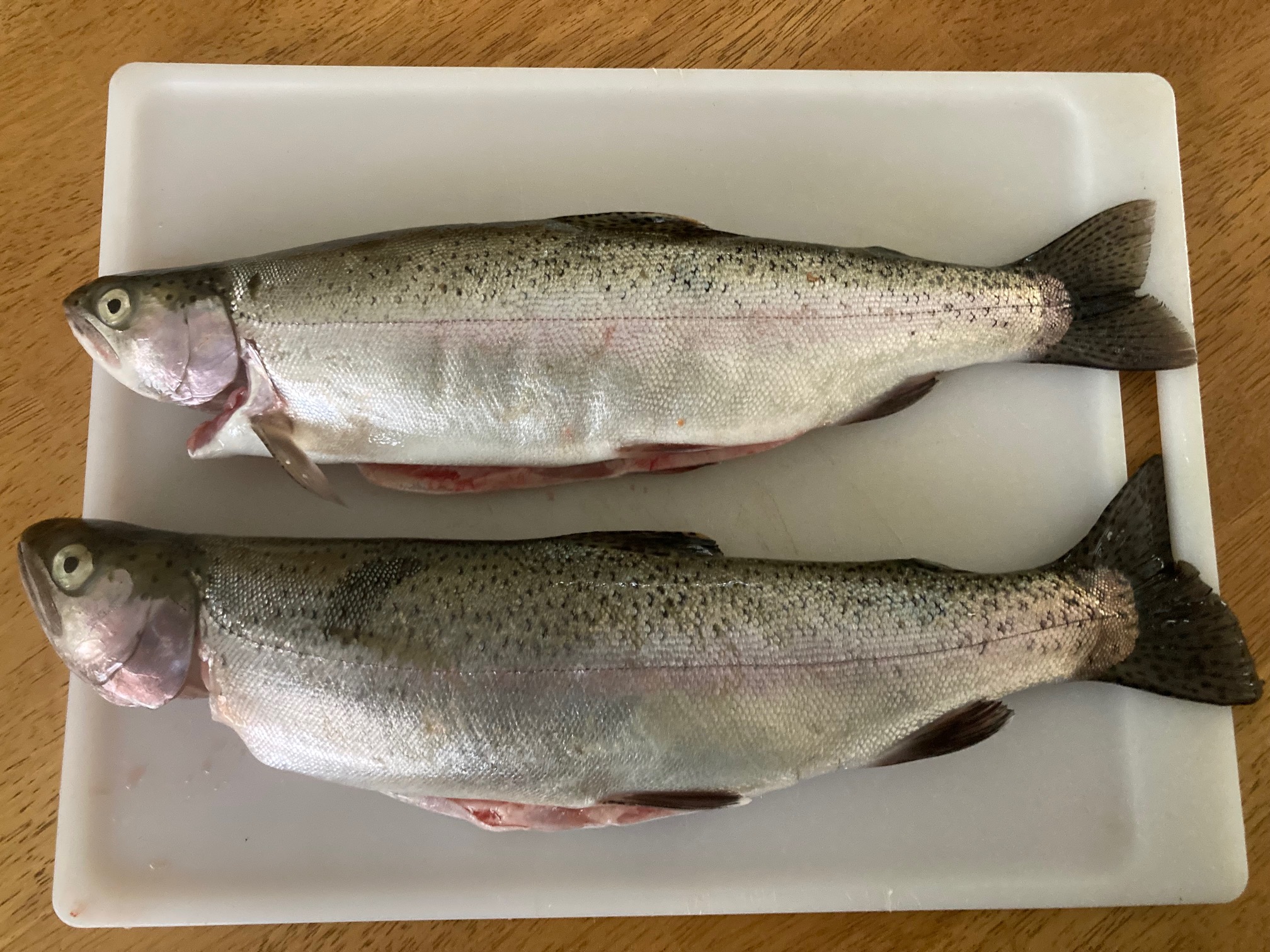
While the vast majority of the fish I catch end up back in the drink (on purpose), once a year I keep a couple. Something about a fish you just pulled out of the water, successfully hooked even when the elements conspire against you, tastes better.

Today, we are grilling whole trout. First, you need to gut the fish, which means running a knife from the vent (it’s back toward the tail) to the head and pull out the guts and gills. Season expertly inside the cavity with salt and pepper and then fill it with fresh herbs and slices of lemon and onion. Wrap carefully with overlapping slabs of prosciutto and put it on the grill, cooking each side 10 minutes or so, depending on the size of your fish. As always, you want to avoid overcooking, but you don’t want it underdone either. The prosciutto will crisp up, but don’t let it burn. In other words, bring your glass of Muscadet with you and be mindful. Don’t let your attention drift too far away. This is not the time to squeeze in a game of Jarts. Those fish just died for you – pay your your respects.

Serve with something cold and refreshing on the side. You might like potato salad, but I’ve developed a taste for tabouleh, the Lebanese salad made with parsely and quinoa.

I leave you with the usual clip, this one from Mr. Zimmerman:

Posted in Uncategorized | Tagged , , , , | 2 Comments

Sea Bench

I sat on a bench today.   

I sat on a bench overseeing the ocean 

On a high sea cliff 

Squinting in the sun. 

I sat on the bench and three pelicans skimmed by below me 

Wings fixed, searching baitfish. 

Today, I sat on a bench by the ocean. 

Wind and sun and salt and sea. 

A set of waves rolled in and broke on the beach, 

As though to their last end, their journey complete. 

I sat on a bench by the sea today  

When suddenly 

Nothing happened.   

Squid’s Stuffed Squid

While not a typical food for pelicans, squid are a forage species for many critters. They are plentiful and extremely healthy, being high in protein and very low in fat. Most people have had calamari as an appetizer, cut into rings, floured and flash fried. They are also a great ingredient in pasta, paella, risotto and many other recipes, being delicately flavored.

However, squid can be tricky to cook. After years of trial and error (with the result being a dish that resembled rubber bands in texture), I finally learned of a helpful rule of thumb – cook squid either less than three minutes or over 30. Either end of that spectrum will give you a very tender and tasty dish.

While I like squid lots of ways, one of my favorites has become Squid’s Stuffed Squid. For this dish you will need whole squid bodies and their tentacles. If you can get them cleaned, great. If whole, you will need to cut off the tentacles and pull out the guts without tearing the body. Be sure to get the thing that looks like a strip of plastic along with its rather gelatinous innards. Once you are set up with the cleaned, whole squid bodies, it goes something like this:

Place a pot of water on the stove and bring to a light boil. Drop the squid bodies into the boiling water for about 10-15 seconds, just long enough for them to set. This step will make stuffing them MUCH easier. Take the bodies out of the water and submerge in an ice bath to stop the cooking and set them aside

Chop the remaining tentacles finely.

Finely crumble a small amount of bulk sausage and saute until just done, breaking it up into the smallest pieces you can. When the sausage is just done, add the finely chopped tentacles and saute another 30 seconds. Remove from the pan in place in a small mixing bowl.

To the sausage/tentacle mixture add a couple tablespoons of panko, a couple of minced garlic cloves and chopped parsley. Season lightly with salt and pepper and mix thoroughly.

When the mixture is cool enough to handle, stuff it into the whole squid bodies. You can do this with a small spoon, or place the mix in a baggie with one of the corners cut off and squeeze it into the body. Be sure that the mixture gets all the way to the tip end of the squid but don’t overfill as the mixture will expand as it is cooked. Once filled, close the open end with a toothpick. Drizzle the stuffed bodies with olive oil and perhaps a squeeze of lemon.

To cook, you can put these over a grill, broil in the oven on the low setting or saute in a non-stick pan. Grilling is my preference. Cook no more than a couple minutes, just long enough for grill marks to form and for the inside stuffing to be heated through. Remove from heat and serve immediately. If you have very large squid bodies you can cut them crosswise, they will hold together.

As an appetizer, figure 2 bodies per person.

A Spanish albarino would be a nice wine to drink with this.

Here is a music clip to enjoy while cooking squid and waiting for your real life to begin…

Posted in Uncategorized | 5 Comments

Cheers

Well, friends and gentle readers, the holidays are upon us, complete with carols, presents, the fat man, and – for some of us – copious cups of Christmas cheer. In past years, you would find me on or around this date making a list and checking it twice, for the purpose of stashing my cupboard with libations of various types: vodka, gin, tequila, the spectrum of wine shades, scotch…you know, that sort of thing. Oh yes, a nice cognac or/and a thin bottle of Calvados might be in order as well. And good vermouth for martinis! I make mine with a healthy splash of vermouth, so it has to be the good stuff. My dear wife enjoys a sip of Bailey’s Irish Cream on Christmas morning along with whatever the elves have placed under the tree for her, so there would be some of that as well. From time to time, I might even mull some wine. If you have been to my home over the holidays and you went home thirsty, it wasn’t my fault. 

I’m not sure exactly how to put this, other than to come straight out with it:  I will enjoy the holidays differently this year. That is to say, they will include decidedly less alcohol consumption than in previous years.  There, I said it; the secret is out. I have quite nearly quit drinking. 

A few months ago, my doctor (a cardiologist by trade) mentioned in passing that at least one critical function of my blood pumper was “sub-optimal,” and that we would therefore be commencing on a journey to gather more data and determine how best to ameliorate the situation. He also mentioned (almost parenthetically) that alcohol use could be a factor, but that we would wait and see what the tests said before taking further action.  While I was too ashamed to admit it out loud, my inner angel (who bears a significant resemblance to my mother) scowled and tsked-tsked me, as I had fairly significantly under-reported my weekly alcohol consumption on the check-in paperwork. I had a pretty good hunch he had put his finger on the pulse of the problem  (and being a cardiologist, that is sort of his job). 

I am disinclined to over-share the details on account of really hating to be an abstinence bore, but I have significantly reduced my boozing in the four months since, and currently enjoy five dry days a week, with moderated consumption on the other two days. Prior to this, I can’t remember how long it had been since a single day passed without a drink, but it was probably at least a decade. Any doofus could have concluded that drinking the way I was would eventually catch up to me in some fashion. However, those of us who have a habit like this seldom take advice from any old doofus, however possessed of common sense they might be. I went to the doctor regularly and all my blood tests came back fine. My liver worked; I had reversed pre-diabetes by cutting down on ice cream and cookies; I was never hungover, etc., etc., etc. Everything was fine, except for a creeping waistline that resisted reduction despite hours upon hours at the gym. My blood pressure was a little high, but easily controlled with a couple of very small pills. The atrial fibrillation I  treated 15 years ago has been a non-issue since. When it came to drinking, it appeared I wore Superman’s cape. And I was proud of that fact.  

Jump cut:  the good news is that it appears as though moderation works for me. A second echo cardiogram taken six weeks after pumping the brakes on my boozing revealed that my heart now ejects blood at the proper fraction. Lucky me! I don’t need a pacemaker, more drugs, or any other questionable interventions. All I had to do was quit drinking most of the time (Sarcasm Meter™️ engaged). If you know me, you know that taking a drink at the end of a long day of meeting donors, sending emails, and writing reports was a pleasant way to smooth off the rough edges of what (for me) was a bristly business. The tinkling music of ice cubes in a silver metal shaker, a burble of Bombay Sapphire gin, and a healthy splash of Noilly Prat vermouth was as pleasant a chord as any created by John, Paul, or George (and I like to think that Ringo would have appreciated my approach to mixing a martini). Shaken, not stirred, with a full skewer of olives.  I even have a splendid and revered collection of glass olive skewers and fancy martini glasses. Hey, when I’m in, I’m all in.  

My new routine allows me one martini a week, or perhaps a couple of glasses of wine with weekend meals. Given my former habits, I might as well be pouring my libations into a thimble. However (and this is a big however), my enjoyment factor of that single drink is quite off the charts. What used to require a good two or three  sizeable wallops to engage that enjoyment is now accomplished in a similar number of sips. And since I am no longer going through wine at anywhere near my former pace, I now allow myself a higher grade of grape. When a bottle lasts a week, you can drink way, way better than Trader Joe’s cardboard box wine. Not that there is anything wrong with Trader Joe’s, mind you. But the words of friend who owned a wine shop ring in my ear: when asked about TJ’s box wine he winced slightly and commented, “It is fairly priced.”  

I pen these lines with no little trepidation, as I know and love people for whom moderation does not work and I don’t want to step on their feelings. Their lives literally depend upon not taking so much as a sip. Some cannot even manage an alcohol-free beer – alcohol-free meaning less than .05% – so not technically alcohol free, although I have no idea how one’s body or brain discerns such a miniscule amount. But we all have our limits, and if your limit is really none, then you are better off with none. I feel hugely fortunate that I am (at least for the time being) able to live with moderation.  

As is often the case, my own thoughts on this subject are echoed (not to mention articulated better) by the late, great Jim Harrison, who also had to significantly rein in his Olympian alcohol utilization. Via Men’s Journal, Jim shared the following 13 thoughts, based on his experience and imagination:  

  1. Drinking causes drinking.  Heavy drinking causes heavy drinking.  Light drinking causes light drinking. 
  2. The ability to check yourself moment by moment has been discussed at length by wise folks from the old Ch’an master of China all the way down to Ouspenskii. This assumes a willingness to be conscious.
  3. The reason to moderate is to avoid having to quit, thus losing a pleasure that’s been with us forever. 
  4. We don’t have much freedom in this life, and it is self-cruelty to surrender a piece of what we have because we can’t control our craving.
  5. Measurement is all. A one-ounce shot delivers all the benefits of a three-ounce shot. A couple of the latter turn one into a spit-dribbler. Spit-dribblers frighten children and make everyone else nervous.  
  6. With any sedative there is a specific, roomy gap between smoothing-out and self-destruction. There is no self-destruction without the destruction of others. We are not alone. 
  7. Naturally there are special occasions. When you get older like me, it’s once a month, if that.  
  8. It’s hard to determine pathology in a society in which everything is pathological. The main content of our prayers should be for simple consciousness. The most important thing we can do is to find out what ails us and fix it. Often we need outside counsel, for clarity and to speed up the process.  
  9. A lot of overdrinking comes from feeling bad physically. One over-drinks to feel better in physiological terms. This can be avoided by vitamins, exercise, and a reasonable diet. Again, it’s a cycle: Overdrinking causes overdrinking because you feel bad.  
  10. Another source of the problem is the unreasonable expectations we get from others and ourselves. Unreasonable expectations can be removed by thinking them over. They can’t be “drownt,” pure and simple.  Everyone can’t get to the top, or even the middle. 
  11. Oddly enough, our main weapons in controlling drinking are humor and lightness. The judgment of others and self-judgment (stern) are both contraindicated. When we fuck up, we mentally beat ourselves up. It doesn’t work at all and has to be expunged. The reason to slow down is to feel better, and it works real good.  
  12. You begin by cutting it all by a third. After a few weeks you go down to a half. After that your soul will tell you, when you listen. Often it is simply a matter of one drink too many.  
  13. We need always to separate the problem of virtue from the problem of lack of control.  Certain countries – France, for example – drink more alcohol but have fewer problems.  This is partly due to the predominance of wine, which has less of a stun-gun effect on behavior, but also because drinking isn’t connected to virtue or non-virtue.  It is a practical problem.  Drinking has to be strictly self-controlled the moment it negatively affects our character and behavior.

There you have thirteen observations about modulated drinking by a guy who would certainly know, based on his considerable experience, offered for your consideration. Though encapsulated in just a few lines, there is a lot of wisdom to unpack here, and each point probably merits a chapter or more of elaboration.  But this is maybe one of those times when less is more.  Just like drinking.  

John’s Classic Martini

My Dad wasn’t much of a Martini guy (he liked his Old-Fashioned) but since his middle name was Martin, I offer this in his honor:  

1.5 oz Bombay Sapphire gin

.5 oz Noilly Pratt vermouth 

Skewer full of green olives, preferably stuffed with blue cheese (not anchovies, ish)

Fill a shaker with ice and splash in the gin and vermouth. The 3:1 ratio is critical. This fad of the “dry” where one rinses out the glass with vermouth is basically a glass of cold gin.  That’s fine if that is what you want.  But a martini is way better than chilled gin.  

Shake that moneymaker. Shake it hard.  I know there are people who think this bruises the gin, but I have experience in this area and I can tell you that if it bruises, it’s not in a bad way. The key is that you want tiny shards of ice in your drink that will very subtly water down the drink. The effect here is the same as with Scotch, which any Scotsman will tell you should be served with a splash of cool water (the problem with neat Scotch is a story for another day).  

Pour the drink into a suitably fancy triangular shaped glass or perhaps a coupe and finish with the skewered olives. If you are feeling a bit contrary, finish with some pickled onions on that skewer.  Voila, your Martini becomes a Gibson.   

Here is a suitable tune, served with a side shot of irony:

Amanda Anne Platt and the Honeycutters – Let’s Get Drunk

Cheers.  

Posted in Uncategorized | Tagged , , , , | 6 Comments

Truly, Offal

“Leopold Bloom ate with relish the inner organs of beasts and fowls.  He liked thick giblet soup, nutty gizzards, a stuffed roast heart, liver slices stuffed with crustcrumbs, fried hencod’s roes.  Most of all he liked grilled mutton kidneys, which gave to his palate a fine tang of faintly scented urine.”   

from Ulysses, James Joyce

If you’re like me and/or Leopold Bloom, some of the best dishes you have had in the last decade or so have been, well, offal.  While I admit that a “fine tang of faintly scented urine” seldom makes my mouth water, the appearance of organ meats on a menu makes my heart pitter-pat.   In fact, three of the very best things that have passed my lips and tickled my palate the last decade or so have been truly offal (I promise to quit jumping on this homonym with both feet for the time being).   

While it seems a shame to extol the virtues of a now shuttered establishment, Exhibit A in our organ meat tour was procured and devoured at the now-closed Standing Stone Brewing in Ashland, Oregon.  Weary from a day of fighting sleet and snow while driving from Seattle southward, we stopped in Ashland and landed at Standing Stone purely by accident.  Thirsty for a decent beer and unwilling to move the car, we shuffled in circles around the historic. A crust of sleeted snow covered the sidewalks of downtown Ashland and the mercury dipped into the twenty-somethings as the sun set. Falling faintly as though unto my last end through the door of Standing Stone we emerged into a warm and hospitable roadhouse that was Standing Stone.   Without looking at the menu, I knew this was the place.  

 Pondering either the burger or the fish and chips to go with a pint or three of their finest pilsner, our waitress informed us that there was still one serving left of the daily special – tongue taco served street-style with rice and beans. While I typically only eat Mexican food at restaurants that specialize in south of the border cuisine (if not run by actual people of Mexican ancestry) the prospect of a tongue taco made my selection easy.  Handing over my menu, I went with the special.  And, I am here to tell you, it was not only special, but delicious.  Clearly someone in the kitchen at Standing Stone was paying attention and cooking with intention.  Had I mre opportunities to stop for the night in Ashland, I would have been a regular there and perhaps they would still be in business.  When somebody coined the term Gastropub, it is kitchens at places like Standing Stone that they were thinking of.  The tongue itself was tender and delicious and the topping of salsa selections (fresca, verde and rojo) were all terrific.  Like Leopold Bloom, I tucked in with relish, both literally and figuratively.  I also ate them with house made tortilla chips and some rustic, lumpy guacamole.  So confessions?  I may have licked my plate.  

At the risk of having this column turn out to be more restaurant review than meditation on the virtues of offal, I offer Exhibit B: the daily terrine at The Simone, also now closed due to Covid complications.  The Simone was, quite frankly, the restaurant I would have selected without hesitation if you told me I had one last meal out.  While the food was fantastic and Chef Chip Smith is a peerless cook in the French tradition, the reason for the Simone being my final culinary destination is for the experience as a whole.  I don’t want to get into anything resembling a restaurant review, but the redeeming virtue of The Simone is that it is a decidedly analog experience from start to finish, thanks to the calm and poised atmosphere created by Tina Vaughn, spouse of Chef Chip. The Simone was a gastronomic refuge from the scurry of the digital age.  Being cheaper than Le Bernardin and Daniel was a virtue, but if I were to choose a restaurant just for the pure existential enjoyment that it brings, full stop, I would choose The Simone 7 out of 10 times over those two destinations.   

I bring up The Simone because it so happens that Chef Chip is an absolute master of the terrine, a special that changed daily depending on what was inspiring the chef.  Of course, the basis of these splendid slabs was liver, usually chicken but often duck.  Even people who say they hate liver (or any organ meat for that matter) are often beguiled by a nice pate or terrine.  As for me, I am happy unto bliss by the sight (not to mention smell) of a plate of sauteed chicken livers, seared on the outside but still a bare pink, covered with a red wine and shallot reduction.  But Chip Smith’s terrine?  These are works of art, liver ground into forcemeat, then studded with whole chunks of rabbit or lamb, pistachios, prunes and pignolis. Each day’s terrine at The Simone was a new creation, edible artistry. Thinking of this, I am reminded of the (now disgraced) chef Mario Batali who once said, “I create works of art and my patrons turn them into shit in 24 hours.”  Like a broken clock, even a thieving, sexually abusive chef is right twice a day (sorry Mario).   

My third and final argument for the inner organs of the beasts and fowl is from the Barcelona Wine Bar, a micro-chain outfit that I discovered while on a work-stay in the Brookline neighborhood of Boston.  BWB has some 20 locations scattered among 11 states, including (but not limited to) such odd locales as Nashville and Denver. As chain operations go, it is pretty good with a nice/affordable selection of wine from the Iberian Peninsula.  The regular menu is standard Spanish tapas fare (jamon, Manchego, patatas bravas, croquettes…), toned down for American tastes.  However, the two nights I was there, they had an off-menu special that was decidedly tuned-up – skewered, wood-grilled duck hearts slathered with a house-made green harissa paste.  The first night I ordered a second plate of hearts while the second night I just ordered two to begin with.  The hearts were grilled to a mellifluous medium rare.  The pumpers were plump, juicy and delicious and the green harissa provided just enough of a jolt to keep things interesting.  This special was not found on subsequent visits to other BWB locations, so this may have been a totally one and done deal.  Lesson being, when duck heart is offered, do not hesitate.  Since those visits, I have been trying to procure a stash of duck hearts myself, but to no avail.  It makes one wonder, What have they done with the hearts?   

While injecting politics into my eating is a sure-fire way of making me lose my appetite, I must admit there is at least a modicum of moral/ethical element to eating.  I am certainly not about to go vegan or even vegetarian as a political or even moral statement. However, I do seek the high ground when feasible and eating organ meats moves me modestly in that direction.  If we are going to murder animals for our gustatory enjoyment, the least we can do is make the most use of them as possible, not to mention preparing them with intention.  Those chicken feet?  They are terrific added to the carcasses when making a stock.  And that offal?  Much is delicious as I have noted above.  Thus, eating that liver, heart, gizzard, pancreas (sweetbreads?) and stomach (mmm, tripe) is an edible/ethical win-win.  Not only are they delicious but consuming them lifts an eater a few inches higher on the moral high ground.   

An Offal Dish 

Getting back to the original format of Meezenplace (my meezings, if not musings) I offer up my own organ concoction: Kung Pao Gizzard.  As noted above, gizzards are like rubber bands if not simmered first.  The side benefit to this is that you get a wonderful stock for chicken or turkey gravy, so save the poaching liquid, it’s pure gold.  Once you have softened the gizzards, you can use any recipe for Kung Pao that you like.  I particularly like this one.   

Kung Pao Gizzard 

Chicken Gizzards (a pound should make 4 servings) 

Coarsely onion, carrot, celery and leek 

Rinse gizzards thoroughly and trim the silver skin.  Place in a pot with the vegetables and cover with water.  Bring to a boil and then reduce heat to a simmer.  Skim any foam that is released.  Simmer very low for 2 hours, adding water if necessary.  Remove gizzards and vegetables from pan and reserve the remaining stock for another use (this will make amazing chicken gravy).  Coarsely chop gizzard meat into bite-size pieces, not too small.   

8 scallions, chopped coarsely 

1 stalk celery, chopped 

2 cups coarsely chopped zucchini 

1 cup coarsely chopped red pepper 

For the sauce: 

1 tbs dark soy sauce 

1 tbs light soy sauce 

3 tbs black rice vinegar 

1 tbs Shaoxing rice wine 

4 tsp sugar 

4 tsp cornstarch 

Mix sauce ingredients and set aside 

Black rice vinegar and Shaoxing wine are not on the shelves of Safeway, but ff you are going to the trouble of finding a pound of gizzards, you might as well procure those items as well.  Yes, it does make a difference.  

For the stir frying: 

Cooking oil (peanut oil is best but canola is OK) 

15 small dried chilis, halved and seeds removed 

2 tsp whole Sichuan peppercorns (see comment above regarding Shaoxing wine and black rice vinegar) 

6 cloves garlic, sliced 

8 slices ginger 

Roasted peanuts 

Get your wok smoking hot and then add the gizzards for about 30 seconds.  Remove from the wok and reserve. Add cooking oil and then the chilis and Sichuan peppercorns, sauté for 30 seconds.  Add the garlic and ginger and sauté another 30 seconds.  Add chopped vegetables and sauté about 2 minutes (don’t overcook, they should be still crisp).  Add the gizzards back to the wok and stir with veggies until well mixed.  Stir up the sauce and add to the wok all at once, stirring as you go.  The sauce will thicken quickly.  Once the sauce is distributed to coat all ingredients and thickened, add roasted peanuts.  Serve with white rice.   

OK, I admit this is just a chicken kung pao replacing cubed chicken breast with the simmered gizzards.  But, it is terrific, trust me on this.   

I can’t believe that none of my prior posts have included a musical clip from Bonnie Raitt. This one is from the late last century and features some tasty slide work on her Fender Strato-caster. Not too many songs about organ meats out there. Sometimes you just get lucky.  

Bonnie Raitt – Have A Heart – 11/26/1989 – Henry J. Kaiser Auditorium (Official) 

Posted in Uncategorized | Leave a comment

Labor Day

She sits
She sits on a folding chair
She sits on a folding chair in the sun next to a flatbed truck piled high with corn
It’s 92 in the shade but there is no shade
Just sun
And a truck
And corn on the cob
Parked in the lot of an abandoned mall
Cedar Mall
Cedar Mall, the shopping mall that delaminated the downtown of Owatonna, Minnesota
I pull up in a rental car
Now a stranger in my own home
I pull up and get out
I pull up and get out and I ask how much
Five dollars a dozen
Five dollars a dozen for the best corn on the cob
Bought off a flatbed truck
From a girl who sits
In the sun
On a folding chair
A strand of brown hair falling over her face
Is this corn local you ask, making conversation
Just making conversation
Her face falls like it will fall again, a hundred times, a thousand
No, it’s from Rochester

Recipe: Corn on the Cob

Most of the time, I think I can improve a dish, tweak it here, add a couple ingredients there…make it mine. Make it better. With corn on the cob, not so much. People grill it or cut off the kernels and saute with red pepper, etc. etc. And I’ve done all that. But really, you can’t improve corn on the cob much beyond butter. Salt. Pepper.

First, get good corn. Local if you can. Or from Rochester, that’s OK. Buy it from a flatbed truck, not a grocery store. Certainly not Walmart.

Then bring a large pot of well-salted water to a rolling boil. The water should be as salty as sea water. Put your corn in and cook for 3 minutes. That’s plenty. Melt some butter. Maybe squeeze some lime into it. When the corn is done, paint it with the butter and lime using a pastry brush. Salt. Pepper. Use good salt, not iodized.

That’s it.

Eat Well.

Posted in Uncategorized | 3 Comments

Bean There/Done That

By popular demand (as in someone asked) I am sharing my recipe for black bean and corn salad.  This is a summertime staple, I make a batch a couple time a months in the warmer months, or when attending those things we used to do in olden times, backyard BBQ picnics.  This salad is great with a slab of salmon, a grilled chicken thigh, some tri-tip…a cold, clean white or rose wine is your go-to with this, or your house beer, in my case Pacifico.  I haven’t measured proportions on this in 20 years, so take these with a grain of salt and your own taste.  Boiling up your own black beans probably improves this dish, but I never seem to get around to that.  Adjust ingredients to your own taste. Regardless, putting this together several hours before eating so that the flavors meld together is highly recommended.

This recipe has a good lime tangy brightness.  If you don’t like that, back off on the lime. 

Black Bean and Corn Salad

One can black beans, rinsed

Equal amount corn (fresh is best, frozen works fine)

One cup chopped spring onion, red onion or green onions. 

One half red bell pepper, fine dice

Optional – One whole chopped jalepeno pepper (ribs and seeds removed)

¼ cup chopped green garlic, OR two cloves minced regular garlic

1 cup chopped cilantro

Chopped mint to taste (I use 10-12 leaves, cut into chiffonade)

Other chopped fresh herbs as available (oregano, marjoram, chives, lemon thyme…)

Salt and pepper to taste

Lime Vinaigrette Dressing

Juice of 2 limes

¼ cup EVOO

TBS ground cumin

Pinch cayenne

Place dressing ingredients in a jar with a tight fitting lid and shake vigorously.

Combine salad ingredients and toss well.  A couple hours before serving, drizzle the dressing over the salad and toss again lightly.  Expertly adjust seasonings. 

Posted in Uncategorized | 1 Comment

John’s Not Authentic Pork Chili Verde

You asked for it, here it is. I love this in the autumn – tomatillos are in season and the salsa gives it a bright, clean flavor. Kick it up with as many jalepenos as you like. Please resist the urge to use canned salsa verde. It will not taste even remotely like this dish.

Pork Chili Verde

1-2 lbs pork shoulder cut into 1 inch cubes

Onion, coarsely chopped

1 carrot, coarsely chopped

3 garlic cloves, diced

16 very small new potatoes (I like the multi-colored ones) OR 1 large russet, chopped bite size 

1 cup each frozen peas and corn

1 cup chicken stock

1 cup reserved tomatillo cooking water

Chili Verde Salsa

8 large tomatillos, husks removed, rinsed well.

1 poblano pepper, seeds and white parts removed

1 jalepeno pepper, seeds white part removed (optional)

4 cloves garlic

Half an onion, coarsely chopped

Salt to taste

Large bunch cilantro (with stems)

To make salsa

Put tomatillos, peppers, garlic and onion in boiling water.  Cook until tomatillos are soft, about 15-20 minutes.  Remove veggies from water and let cool.  Reserve cooking water. When cooled, put veggies and cilantro in food processor with a ladle or two of cooled cooking water.  Pulse and then process until smooth.  Add more water if it’s too thick. It should be the consistency of dipping salsa.  Salt to taste. Set aside.

Assemble the stew

Add pork chunks to dutch oven or large cast iron pot on medium high with a bit of olive oil.  Brown well.  Add onion and carrot, saute 3 minutes.  Add garlic, cook a minute longer.  Add chicken stock and one cup reserved tomatillo cooking water.  This should about cover the pork/veggie mixture.  Bring to a boil then reduce to very low simmer and cover.  Simmer on very low (a few bubbles now and then) for 1.5 hours. Liquid should have reduced by about half.  If it gets too low, add more chicken stock and reserved cooking water.

Add potatoes and 2 cups tomatillo salsa.  Cook 30 minutes longer or until potatoes are tender.  Add peas and corn and cook 5 more minutes on low heat.  Correct seasonings.

Serve with warm tortillas and grated cotija cheese. Best with cerveza, but a hearty red wine works too.

Serves 4.

Posted in Uncategorized | Leave a comment