
We were floating the river, the Mighty Mo (Montana’s Missouri River) in the usual places. I was seated in the bow while my friend the Birddog occupied the stern. While neither of us is from anywhere close to Montana (where the headwaters and most of the best parts of the Missouri are located), we had been fishing this river on annual sojourns long enough to know what was coming around the next bend.

In the middle and on the oars, as usual in those days, was the highly capable Captain Mike Guerin, our “Mo Better” guide. Back in those olden days, Mike would take the summer off from his usual activity (guiding serious anglers for tarpon, permit and bonefish in the Florida Keys) to float dry fly-fishers down the Montana section of the Missouri in search of giant browns and rainbows. Preferably top water feeders showing their heads. Even more preferably, gathered in pods of a dozen or more. Of course, this scenario plays out only so often due to the existence of more variables than an advanced calculus equation. Such as: bug hatches, cloud cover, water levels and temperatures, barometric pressure, wind velocity, the numbers of like-minded anglers, time of day, etc. etc. Some days they are feeding manically, poking their heads up and down out of the water like horny prairie dogs. Other days an upwind fart puts the fish down. Like life, you never know.
This particular summer day was bright and sky blue with a beaming and beautiful sun – horrendously bad conditions for feeding trout dry flies, although it is good for the “bikini hatch”. Trout far prefer cloud cover when it comes to surface feeding, which makes sense when you think about it. Their main predator comes at them from the skies, aliens from above; another galaxy. Ospreys, eagles, pelicans, terns, gulls and numerous other birds feast on top-feeding trout, even more so when they can get a good bead on them, as they can on a sunny day. Hence, when the sun comes out, most trout beat it for the bottom to forage for tiny bug nymphs, while staying out of reach of dive bombers. They wait for the cover of clouds before exposing themselves on the dangerous surface.
Like most mid-summer days in Montana, complications ensued. As the sun rose in the sky toward its zenith, the wind kicked up. Wind is a near constant companion on the Missouri River between Helena and Great Falls (that’s as specific as I am going to get in terms of sharing our location) but it is more of an issue when the sun is out and it starts howling at 20mph or more. That’s good kite flying weather but it makes casting a weightless fly with a floating line and a 5x tippet nearly impossible. At least for me. Also, a good wind beats down airborne bugs. Floating bugs being pretty much the whole idea when it comes to dry fly fishing, wind is a four-letter word. And not one of the good ones.
“Boys, button up those flies,” Captain Mike chattered from mid-boat. “We are going to row downstream awhile to see if we can get away from this wind.” Birddog and I reeled in and secured our flies while Mike started to put his back into the oars.
A break in the action like this affords the angler a few moments to take care of some basic house-keeping. This is a good time to check your hook, add some floatant juice to your fly (not that one!) and examine your line for nicks, cuts and abrasions. Not to mention lather up with sunscreen and sip that warming beer in the cup holder by your knees. You would be amazed at how much can happen when nothing is happening. A break from actual angling does not mean you doze off. Well, not always. While there is no crying in baseball, fishing does allow for naptime.
While examining my own leader and tippet, I found bad news. “Uh-oh,” I muttered from my place in the bow. “Looks like I have a few wind knots here.” Wind knots may not seem like a big deal and in reality they really are not – most of the time. Knots in the leader won’t prevent you from catching a fish, they prevent you from landing them. They occur most often while casting in windy conditions where the slender leader and flimsy tippet get blown out of sync as you flip line back and forth, looping through itself and tying what is basically an overhand granny-knot. Cast that line a few times and the knot tightens down into a death grip that can’t be loosened. These knots are miniscule and you really don’t even notice them until the line is carefully examined. They have no effect on casting, spooking fish or any other of a million things that go wrong when stalking wild browns and rainbows. The problem is that they create a weakness in the line that is exposed when you have a fish on. Even a medium sized rainbow or brown trout, while wiggling and leaping out of the water will snap a knotted leader. Thus, I was duly concerned to find my leader thrice compromised. My next strike was bound to be a fish of epic proportions, which would be assuredly broken off with even a modicum of pressure.
That’s when Captain Mike audibly guffawed behind me. “Wind knot!?”
“Yeah, see,” I replied, swiveling my seat to face him and showing him the compromised leader. “There are at least three.” I paused, realizing that I had just made more work for my devoted guide, who was already otherwise occupied skippering our vessel. “No worries, maybe I can pick them out with my nipper needle.” I’ve never heard a guide say it, but fixing knotted lines has to be one of the worst parts of the job. They will row a drift boat into the wind, free ensnared anchors, tie on new flies every hundred yards and perform all manner of other tasks without a word of complaint. But throw a knot or kinky tangle in your line? That’s when their shoulders droop. I know, I’ve seen it happen. A hundred times.
“Don’t worry about it, I will put on a new leader when we get around the next corner,” Mike replied amiably enough. Then he added the crushing words, delivered with a chuckle. “But that’s not a wind knot, it’s a casting knot.”
Ugh. It’s amazing how replacing one small word changes everything. As a wind knot, the chaotic, contrarian universe was simply having its way with me. Shit happens, as the young people say. But as a casting knot? There the onus was squarely on me. Me and my own personal brand of ineptitude. Operator Error. Oh the Horror and Humiliation.
Chastened, I swiveled my seat back to the front facing position and proceeded to pick at the first knot with the needle end of my line nippers, which is basically a glorified (and often expensive) nail clippers. I picked out the first knot with relative ease and went to work on the other two. Mike pushed the boat against the wind and Birddog nodded off in the stern, his line (not to mention his conscience) free from such amateur behavior. After about 5 minutes, I finally loosened knot number three and freed my dainty leader from its ensnarled state.. Once restored to its factory settings, the kinks left in the once knotted line would straighten themselves out as soon as I hooked a 25” brownie. Which I would skillfully bring to the net using finely honed skill and wiles, not to mention a knotless leader. Did this actually happen? Well, it has.
Parked now in my writing studio, it occurs to me that the whole wind/casting knot deal functions as a sort of literary metaphor, if not a life lesson. Life can throw a lot at you – much of it outside your control. The universe, lacking a mind of its own, exerts its will without prejudice. Some days you win, some days you lose. Alternatively, we humans blame a lot of the bad stuff that happens on the feckless universe when in fact it’s the result of operator error and/or gross ineptitude. Sitting here now at the relatively safe harbor of my keyboard, it strikes me that being able to discern the difference between situations caused by an uncaring cosmos and those caused by our own unforced errors is what brain doctors would call “mighty important”. A healthy dose of self-awareness can help avoid a lot of the knots in your life. If you are lucky enough to have a guide who will remind you of the difference between a wind knot and a casting knot, you are a fortunate son. If they do so with energy that is at once calm and assertive, you owe them an extra big tip.
Still, we can’t flagellate ourselves for every knot we tie in our life lines. Often the best we can do is get out the nippers and needle and pick at that knot until it loosens. Do that enough and you gain the experience you need to tell when you can get the knot out or to chalk it up to a waste of time and just cut the leader. Mastering the skill of untying knots, while esoteric on its face, is a handy competency for life.
Another path is to try to not make the same mistake repeatedly. A couple of days after the wind/casting knot disaster, we were fishing into yet another howling wind. In one hole in particular, trout heads were poking up all over, only to vanish if the boat was pushed too close. To entice one to bite, you had to make a long, accurate cast. Into the wind. Which as it turned out was about 10 feet further than I could heave my line. Captain Mike’s voice behind me kept saying “punch it. Harder. Harder.” I was trying, but my casting was like Mike Tyson trying to punch smoke. The harder I tried, the more failure I piled into my already fragile psyche.
Finally I tried something I had read about, and practiced a little but had never really tested under actual fishing conditions: the Double Haul. Sharing instruction on the double haul is beyond my modest capabilities but suffice to say that it is a method of increasing line speed (and therefore distance) by adding a short tug to the line just as you are going to launch it. A single haul is accomplished when you are throwing the line forward, while the double requires two perfectly-timed tugs: one on the back cast and the other a moment and a half later, on the forward throw. Accomplishing the Haul (uno or doppio) requires more finesse than brawn (yet another life lesson here, I’m full of it today). When executed with grace and dignity (not to mention timing), the line cuts through the wind like a sharpened scythe through dry hay. Luck being with me at this exact moment, I double hauled as though my life depended upon it and stunned myself with a perfect execution. My line loop was tight, launching the leader, tippet and fly through the wind as the proverbial hot knife through butter. The caddis imitation I was fishing landed three feet in front of a fish nose and the current did the rest, delivering the twisted elk fur and feathered hook straight to the waiting fish, who gobbled it hungrily. My rod doubled over and the line straightened. Fish on!
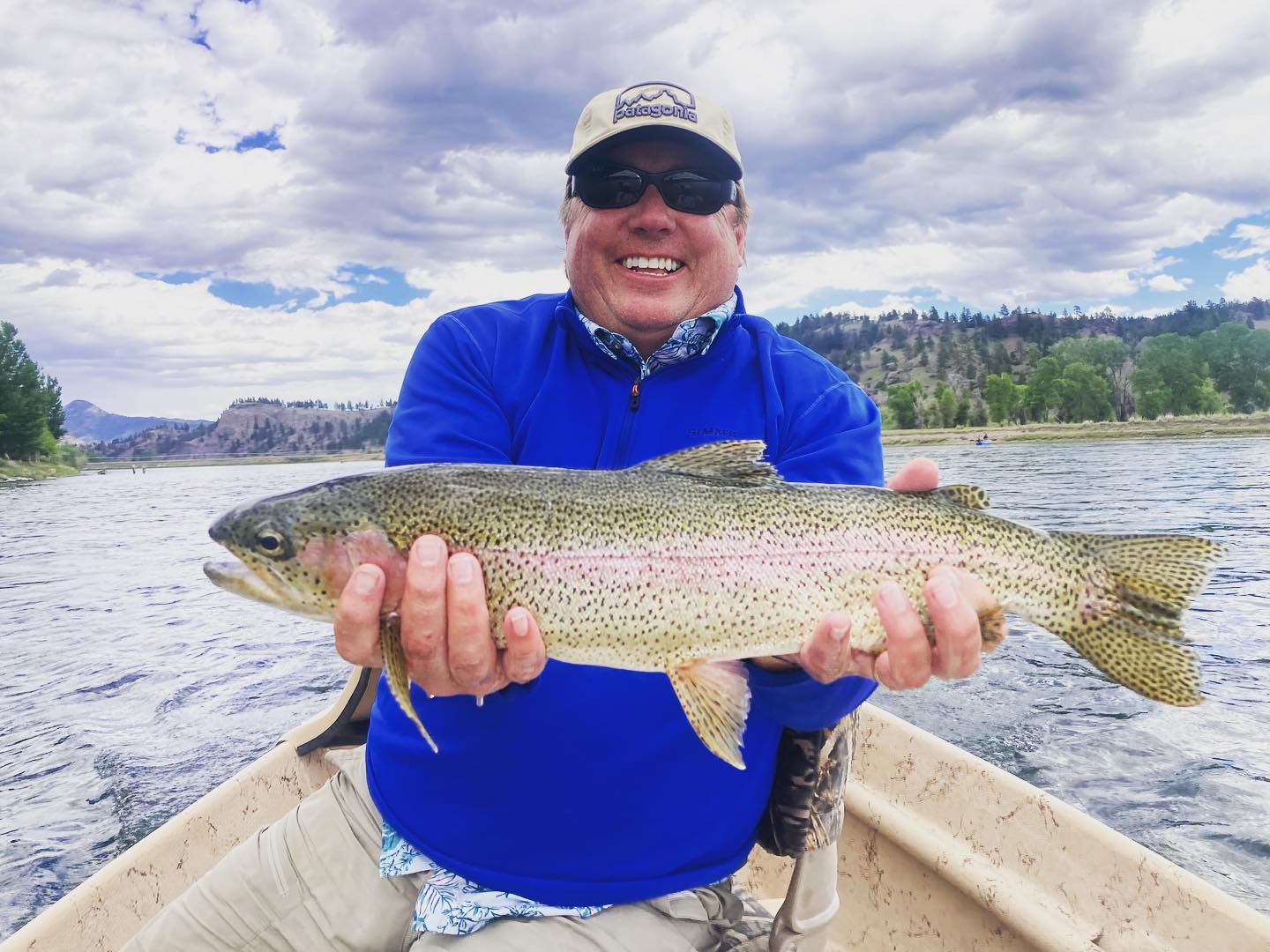
“Nice one!” shouted my mentor in the middle seat. “Nice double haul!” Then a pause before, “Where has that cast been all week?” In a fishing boat, as in life, a balance must be struck. For every compliment an equal and opposite criticism must be levied. It’s fishing physics.
All I could do was shrug. I carefully worked the fish over to the boat, where he was netted by Captain Mike. Smiles and photo ops ensued. A chunky buck rainbow, he measured 19 inches from snout to tail – large but not the behemoth he would be next summer. Still, he fought as though he belonged in the heavyweight division.
I could have tried that cast a dozen more times after that and not come anywhere near the proper placement. If my skill level for fly-fishing matched my enthusiasm, I would be known far and wide. Anglers would whisper my name in hushed tones on the banks of famous rivers. I might even have a fly named after me. But such is not the case. My casting skills, barely proficient for such technical angling, often leave me coming up short. Still, every once in awhile, I get the job done, even if it is just by a whisker. But that’s enough, even if just barely.
Grilled Rainbow
While the vast majority of the fish I catch end up back in the drink (on purpose), once a year I keep a couple. Something about a fish you just pulled out of the water, successfully hooked even when the elements conspire against you, tastes better.
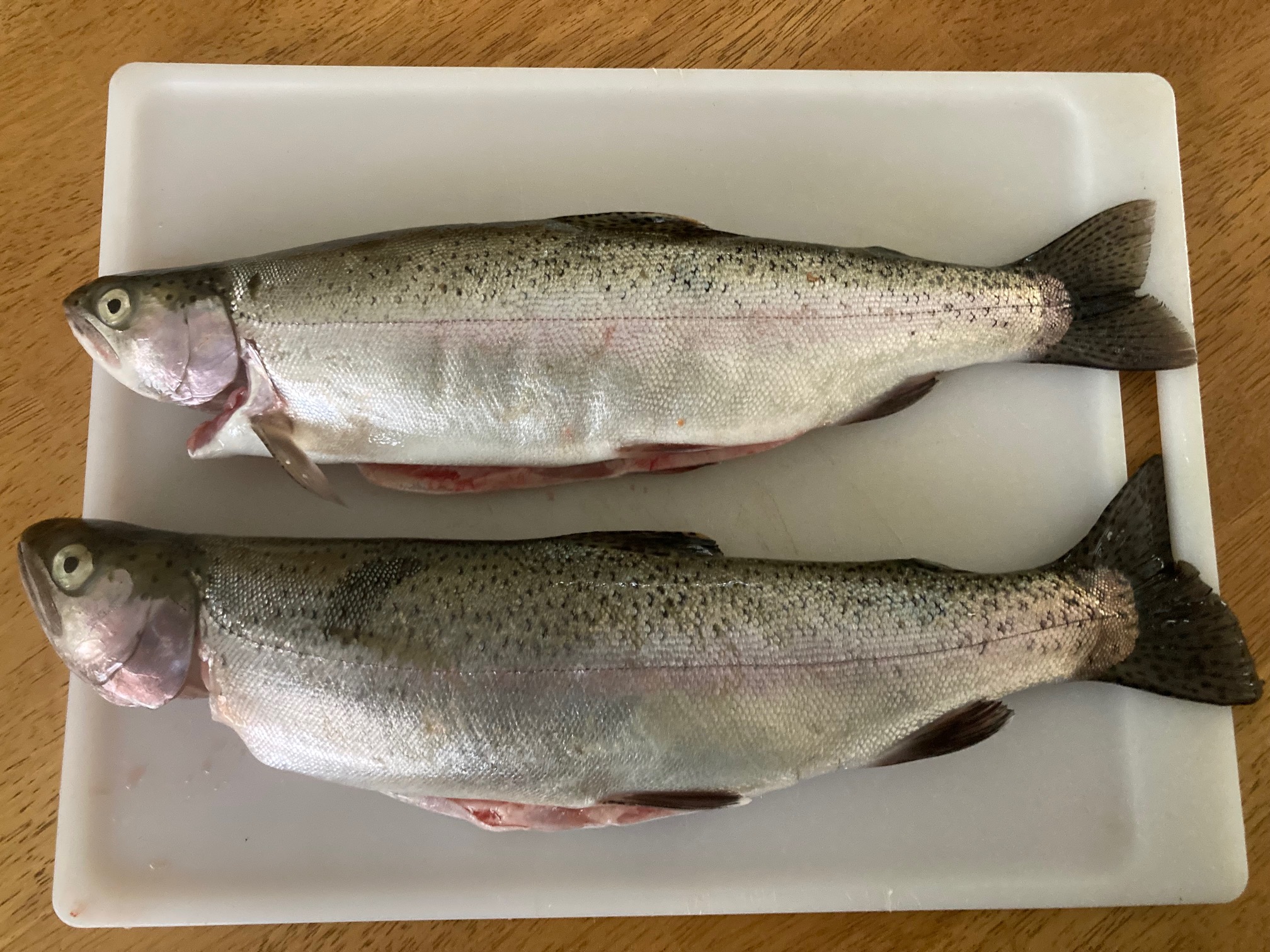
Today, we are grilling whole trout. First, you need to gut the fish, which means running a knife from the vent (it’s back toward the tail) to the head and pull out the guts and gills. Season expertly inside the cavity with salt and pepper and then fill it with fresh herbs and slices of lemon and onion. Wrap carefully with overlapping slabs of prosciutto and put it on the grill, cooking each side 10 minutes or so, depending on the size of your fish. As always, you want to avoid overcooking, but you don’t want it underdone either. The prosciutto will crisp up, but don’t let it burn. In other words, bring your glass of Muscadet with you and be mindful. Don’t let your attention drift too far away. This is not the time to squeeze in a game of Jarts. Those fish just died for you – pay your your respects.
Serve with something cold and refreshing on the side. You might like potato salad, but I’ve developed a taste for tabouleh, the Lebanese salad made with parsely and quinoa.
I leave you with the usual clip, this one from Mr. Zimmerman:


 meezenplace
<
div dir=”ltr”>You’re quite the person! Wonderful descripti
So are you Linda! Thanks for being a reader.